July 17, 2026
The average ransom demand paid by US organizations in 2025 has reached $2 million, according to the 2025 IC3 Annual Report. Recent data shows the median actual payment is closer to $1.4 million globally, with average payments declining roughly 50% from 2024 levels. What the report does not reveal is how many of those payments followed a penetration test that failed to identify the actual entry point attackers later used.
The US cyber insurance market has tightened its requirements in response. Major carriers including Travelers and Chubb now require a penetration test for any policy above $1 million in coverage. Their applications specifically request authenticated internal testing completed within the past twelve months. Without proof of a recent test, organizations face either denied coverage or premium increases of roughly 40 percent.
So, what does a high-quality penetration test actually look like in 2026, and how do you ensure it stops real attacks instead of merely checking a compliance box?
TABLE OF CONTENTS
- What Is Penetration Testing?
- Is Penetration Testing the Same as Vulnerability Scanning?
- Why Is Penetration Testing Important?
- Types of Penetration Testing
- The Three Testing Approaches: Black Box, Gray Box, and White Box
- The Penetration Testing Methodology
- Best Penetration Testing Tools in 2026
- How Much Does Penetration Testing Cost?
- How Often Should You Run a Penetration Test?
- What Should You Expect During a Pen Test?
- Choosing a Penetration Testing Provider
- Red Team vs Pen Test: What Is the Difference?
- Turning Findings Into Action
- Getting Started with Penetration Testing
- Frequently Asked Questions
Main Highlights
- A penetration test is an authorized, hands-on simulation of a real cyberattack in which a tester actively exploits vulnerabilities to prove they are real, going well beyond an automated vulnerability scan that only produces a list of potential weaknesses.
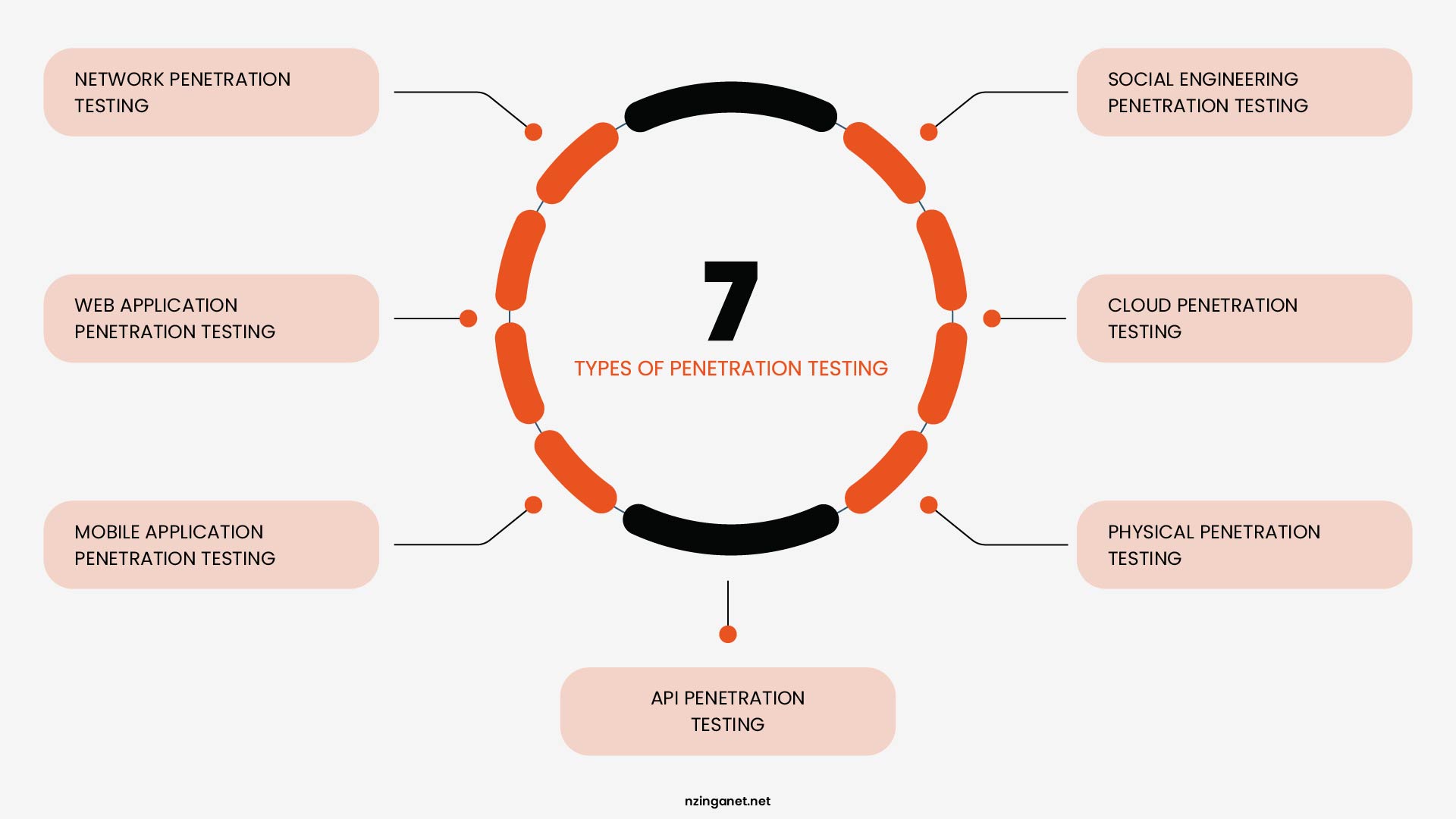
- Organizations can choose from several types of penetration testing, including network, web application, mobile, API, cloud, social engineering, and physical testing, along with three testing approaches (black box, white box, and gray box) depending on what they need to protect.
- Penetration testing costs vary widely, from around $3,000 for standalone social engineering tests to $100,000 or more for comprehensive red team engagements, and most organizations should test at least annually or after significant infrastructure changes.
What Is Penetration Testing?
A penetration test is an authorized simulation of a real cyber attack against your systems, networks, applications, or people. The person conducting the test is often called a penetration tester or an ethical hacker. That person uses the same tools and techniques that a real attacker would use, but they stop when they gain access instead of stealing data or damaging systems. The entire process happens with your written permission and within a defined set of rules.
The goal of a penetration test is to find exploitable weaknesses before a real attacker finds them. A weakness might be a missing software patch, a misconfigured cloud bucket, a weak password, or an employee who clicks on a fake email. The tester does not just list these weaknesses. The tester proves they can be exploited by actually bypassing them.
Without a recent penetration test, organizations remain vulnerable to the exact entry points that lead to ransomware payments and insurance gaps. This is where understanding the fundamentals of penetration testing becomes critical.
Is Penetration Testing the Same as Vulnerability Scanning?
A vulnerability scan is an automated, high-level check that provides a list of known security weaknesses. A penetration test is a deep, hands-on examination by a human expert who actively exploits those weaknesses to see how an attacker might breach your systems.
The key difference is what you get at the end. A vulnerability scan gives you a spreadsheet of potential problems ranked by severity. A penetration test gives you a narrative of exactly what an attacker could access, which path they would take, and how long it would take them to get there.
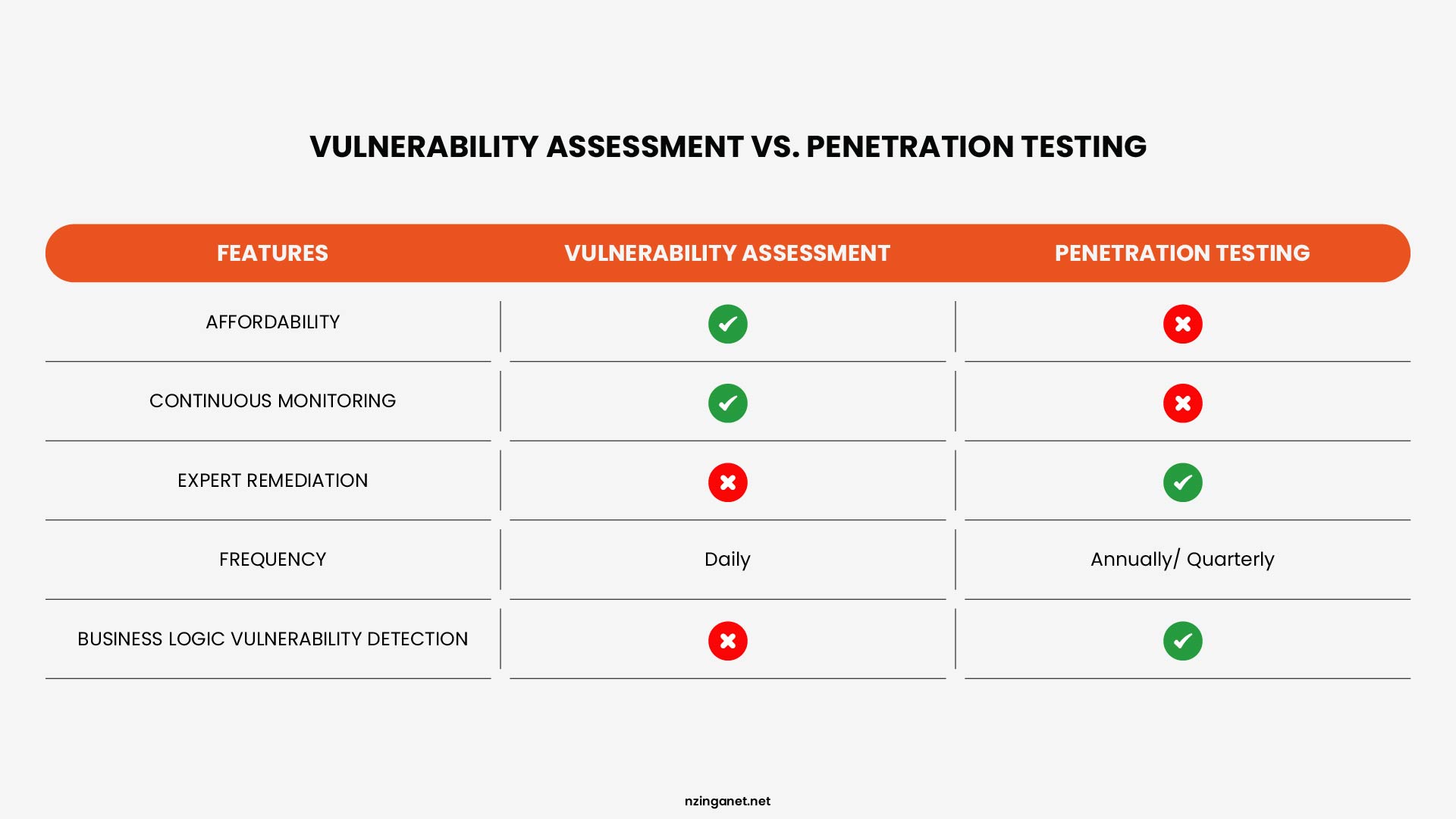
The combined approach is called penetration testing and vulnerability assessment, sometimes written as VAPT. Many organizations run automated vulnerability scans frequently and commission full penetration tests periodically, using both together to maintain a more complete picture of their security posture.
Why Is Penetration Testing Important?
The answer comes down to what you do not know. Every organization has a gap between how secure they believe they are and how secure they actually are. Penetration testing measures that gap directly.
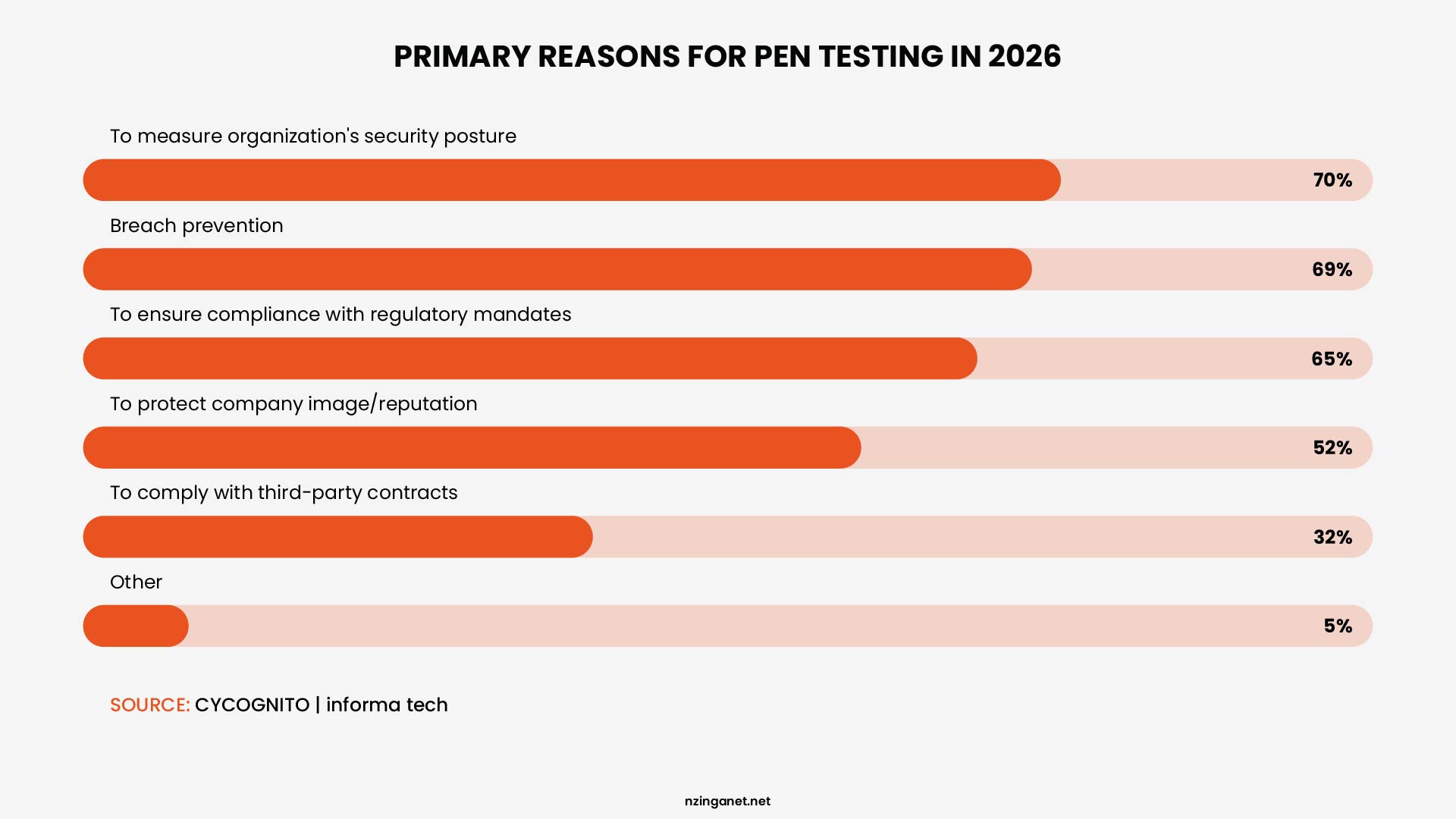
Here are the specific reasons your organization should invest in penetration testing in 2026:
- Attackers do not follow the rules: Automated scanners check for known vulnerability signatures. Real attackers combine multiple small weaknesses in creative ways, use social engineering, chain together misconfigurations, and find paths that no scanner was trained to look for. A skilled pen tester thinks the same way.
- Compliance requirements often demand it: Standards like PCI DSS, ISO 27001, SOC 2, and HIPAA either require or strongly recommend regular penetration testing. Organizations handling payment card data, protected health information, or financial records face regulatory obligations that make pen testing a business necessity, not just a security best practice.
- The cost of prevention is far lower than the cost of a breach: The average cost of a data breach runs into millions of dollars when you account for incident response, legal fees, regulatory fines, reputational damage, and lost business. A penetration test costs a fraction of that and often prevents it.
- Software and infrastructure change constantly: A new deployment, a configuration change, a new third-party integration, or a recently patched system can introduce vulnerabilities that did not exist before. Regular testing catches regressions before attackers find them.
- Internal teams develop blind spots: Security teams that build and maintain a system develop assumptions about how it works. An outside pen tester brings fresh eyes and no inherited assumptions. They attack the system as it actually exists, not as anyone believes it to work.
Strengthen your security with expert penetration testing
Identify exploitable vulnerabilities, validate your defenses, and gain actionable recommendations from experienced penetration testers.
TYPES OF TESTING
Types of Penetration Testing
The type of test you need depends on what you are trying to protect and where that asset lives. Choosing the wrong type of test means you will spend money on findings that do not matter while missing the weaknesses that actually put you at risk.
Here are some of the types of pen testing:
Network Penetration Testing
Network pen testing targets the infrastructure connecting your systems: firewalls, routers, switches, wireless access points, VPNs, and servers accessible over the network. Testers look for open ports that should be closed, weak authentication on network services, unencrypted protocols, misconfigured firewalls, and lateral movement opportunities inside the network.
Web Application Penetration Testing
Web application pen testing focuses on websites, web applications, APIs, and anything accessible through a browser or HTTP. Testers look for injection vulnerabilities like SQL injection and command injection, authentication weaknesses, broken access controls, insecure direct object references, cross-site scripting, and misconfigurations in application logic.
Mobile Application Penetration Testing
Mobile pen testing examines iOS and Android applications for security flaws specific to mobile environments. This includes insecure data storage on the device, weak authentication mechanisms, improper session handling, insecure communication between the app and its backend, and reverse engineering vulnerabilities that expose sensitive logic or credentials embedded in the app itself.
Social Engineering Penetration Testing
Social engineering tests measure whether employees can be manipulated into disclosing credentials, clicking malicious links, or granting unauthorized access. Common techniques include phishing email campaigns, vishing (voice phishing over phone calls), and physical pretexting where the tester attempts to walk into a facility by impersonating a vendor, contractor, or new employee.
Cloud Penetration Testing
Cloud pen testing examines infrastructure hosted on platforms like AWS, Azure, and Google Cloud. Testers look for misconfigured storage buckets, overly permissive IAM roles, exposed management interfaces, insecure serverless functions, and misconfigurations in cloud-native services. Cloud environments introduce a different attack surface than traditional on-premises infrastructure, and organizations often misconfigure them in ways that grant far more access than intended.
Physical Penetration Testing
Physical pen testing attempts to gain unauthorized physical access to facilities, data centers, offices, or server rooms. Testers may attempt to tailgate through secured doors, defeat lock mechanisms, bypass badge readers, or access equipment directly. Physical access often bypasses technical controls entirely, making it a critical part of a comprehensive security assessment.
API Penetration Testing
API testing focuses specifically on application programming interfaces that expose business logic and data. Modern applications rely heavily on APIs, and many have weaker security controls than the web applications they support. Testers check for improper authentication, excessive data exposure, rate limiting failures, broken object-level authorization, and logic flaws in how the API handles requests.
The Three Testing Approaches: Black Box, Gray Box, and White Box
Regardless of the type of test, the tester can operate under three different levels of prior knowledge about the target.
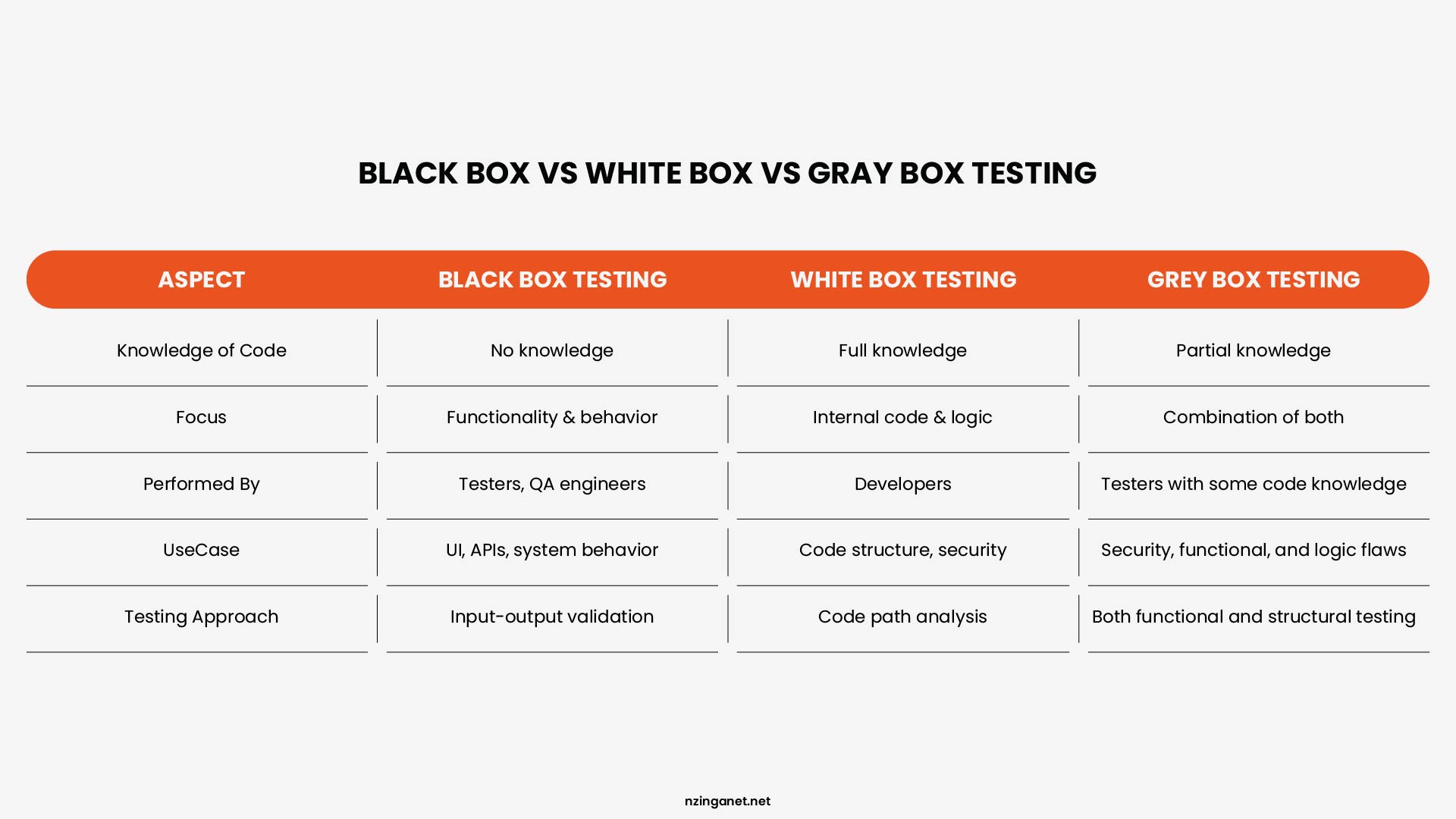
- Black box testing means the tester starts with no information about the target, simulating an attacker with no insider knowledge. This is the most realistic simulation of an external attack, but it takes more time because the tester must first discover the attack surface before probing it.
- White box testing means the tester has full access to documentation, source code, architecture diagrams, and network maps. This approach allows for the most thorough examination of internal logic, code-level vulnerabilities, and configuration details that would be invisible in a black box test. It is more efficient and often reveals deeper issues.
- Gray-box testing combines elements of both black-box and white-box testing. The tester has some information, perhaps credentials for a standard user account or basic network documentation, but not complete transparency. This is a common choice because it simulates an attacker who has done reconnaissance or compromised a low-privilege account.
The Penetration Testing Methodology
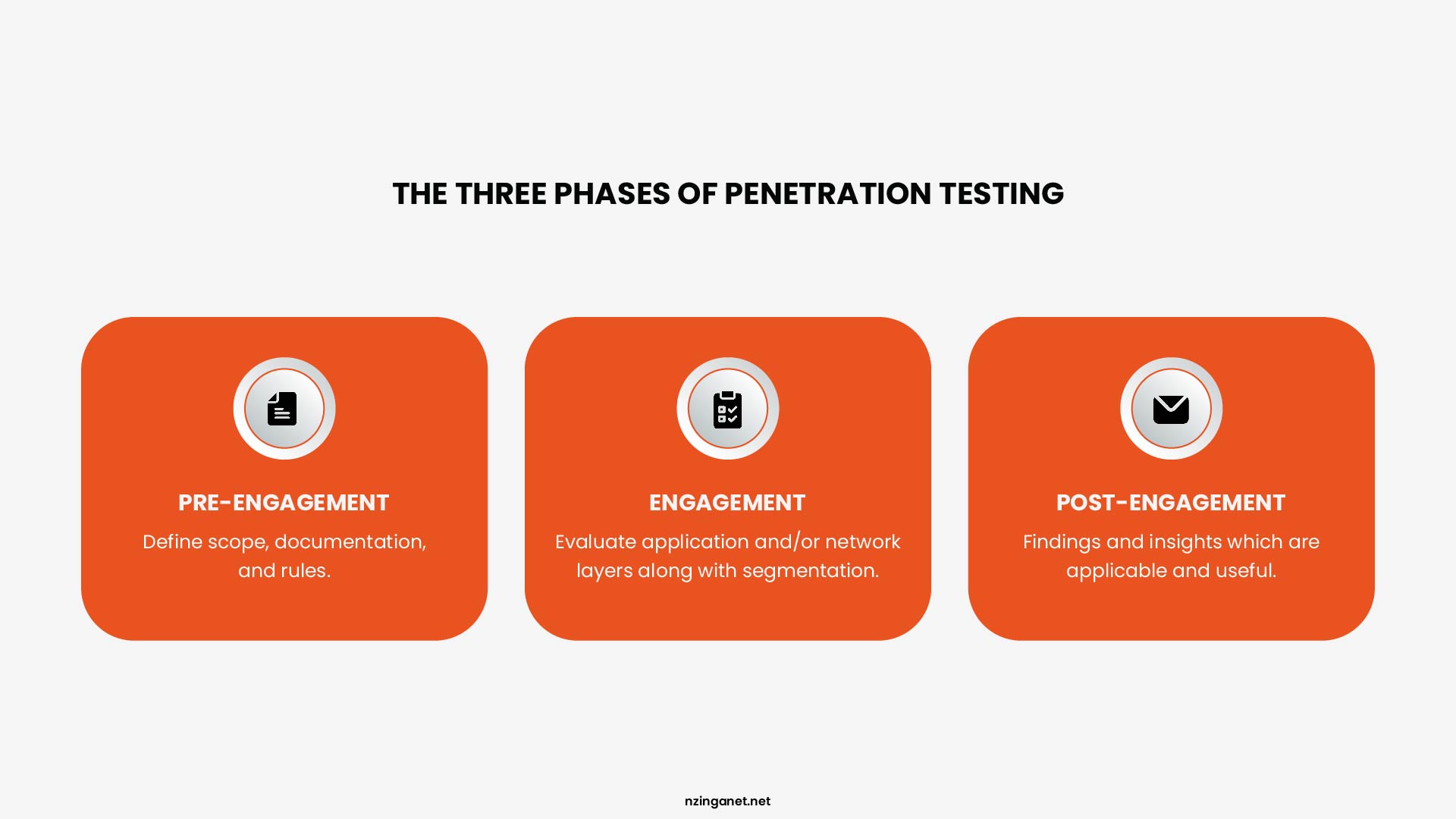
Professional pen testers follow a structured methodology to ensure nothing important is missed and findings are reproducible. While terminology varies, most engagements follow these phases.
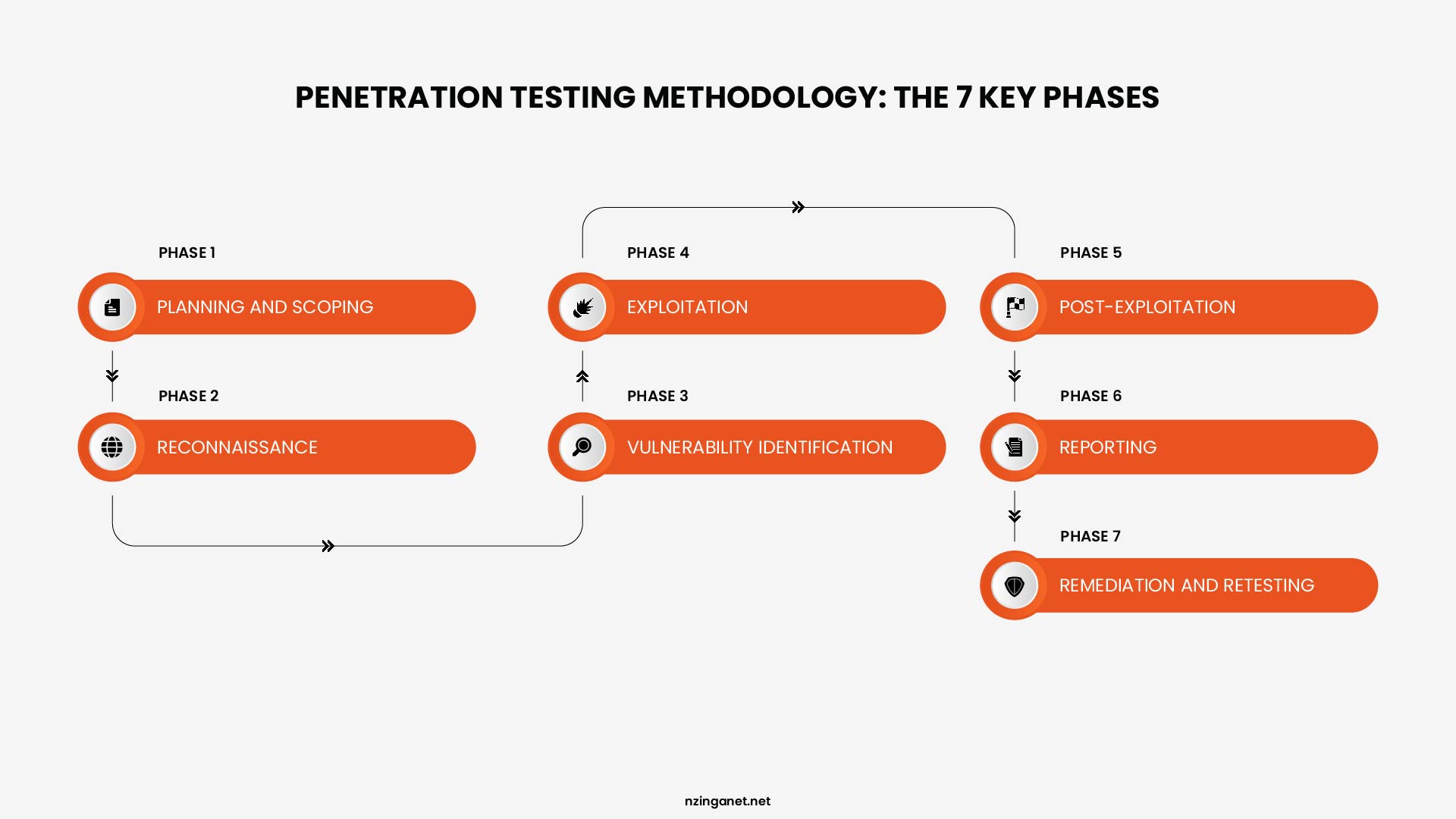
Phase 1: Planning and Scoping
Before any testing begins, the tester and the client agree on scope. This defines exactly what systems are in scope for testing, what is explicitly out of scope, what testing methods are permitted, and the timeframe for the engagement. A clear scope protects both parties: the organization ensures that critical production systems are not disrupted, and the tester has written authorization that protects them legally.
Rules of engagement cover when testing can occur, whether certain systems require advance notice before testing, and who to contact if something goes wrong. This phase also includes gathering intelligence about the organization from publicly available sources, a process called OSINT (open source intelligence).
Phase 2: Reconnaissance
With scope defined, the tester begins gathering information about the target. Passive reconnaissance involves collecting information without directly interacting with the target's systems: looking up domain registrations, certificate transparency logs, employee names on LinkedIn, leaked credentials in breach databases, and public code repositories. Active reconnaissance involves directly probing the target, such as performing port scans to enumerate open services.
Phase 3: Vulnerability Identification
Using the intelligence gathered during reconnaissance, the tester identifies potential vulnerabilities. This combines automated scanning tools with manual analysis. Automated tools catch common, known vulnerabilities efficiently. Manual analysis is required to find logic flaws, chained vulnerabilities, and misconfigurations that automated tools cannot evaluate. The output of this phase is a list of potential attack vectors, ranked by likelihood and potential impact, that the tester will attempt to exploit.
Phase 4: Exploitation
This is where pen testing separates itself from vulnerability assessment. The tester attempts to actually exploit the vulnerabilities identified. If a SQL injection vulnerability was found, the tester tries to extract data from the database. If weak credentials were found on an internal service, the tester logs in and assesses what access those credentials provide.
Successful exploitation proves that a vulnerability is real and shows concretely what an attacker could do with it. It also frequently reveals paths to deeper access. A successful exploit in one system often opens a door to another.
Phase 5: Post-Exploitation
After gaining access, a skilled tester explores what the compromised access makes possible: escalating privileges to administrator or root, moving laterally to other systems on the network, accessing sensitive data, establishing persistent access the way a real attacker would, and determining whether the organization's detection and response capabilities would catch the intrusion. This phase reveals how far an attacker could actually get if they succeeded at the initial breach, which is often the most valuable finding in the entire engagement.
Phase 6: Reporting
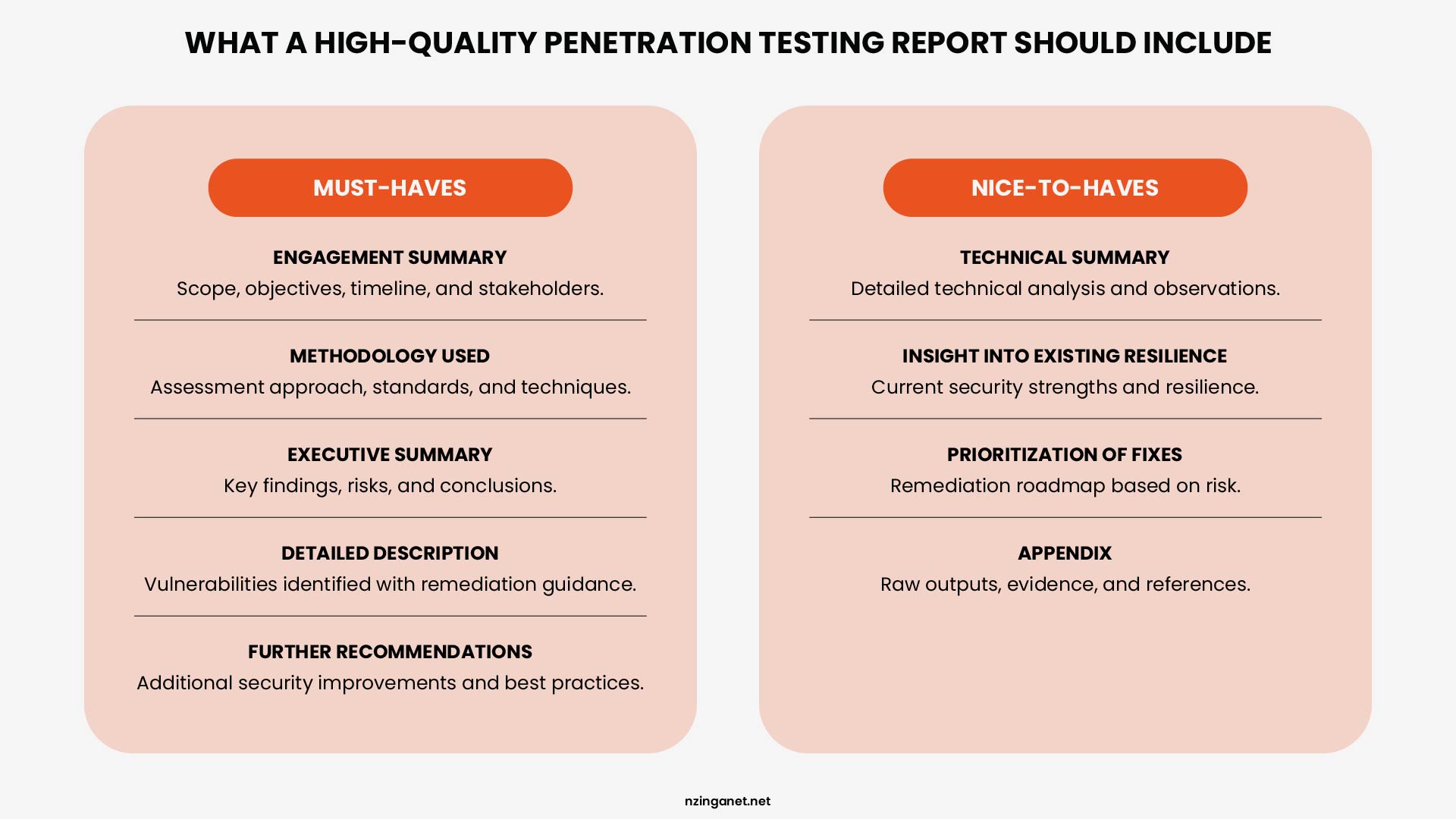
At the end of the engagement, the tester produces a written report. A good pen test report contains two audiences in mind: executives who need a clear summary of business risk, and technical teams who need detailed, actionable remediation guidance. The technical findings section documents every vulnerability discovered, the steps to reproduce it, evidence of exploitation (screenshots, data extracted, or other proof), and a specific recommendation for how to fix it. Findings are typically rated by severity, using a standard like CVSS scores or a custom risk matrix, so the client knows what to prioritize.
Phase 7: Remediation and Retesting
Many engagements include a remediation phase where the organization fixes the vulnerabilities found and the tester retests to confirm the fixes are effective. This closes the loop and ensures that the investment in testing translates into actual security improvement.
Best Penetration Testing Tools in 2026
Professional pen testers rely on a combination of commercial and open-source tools. These are some of the most widely used across different phases of an engagement.
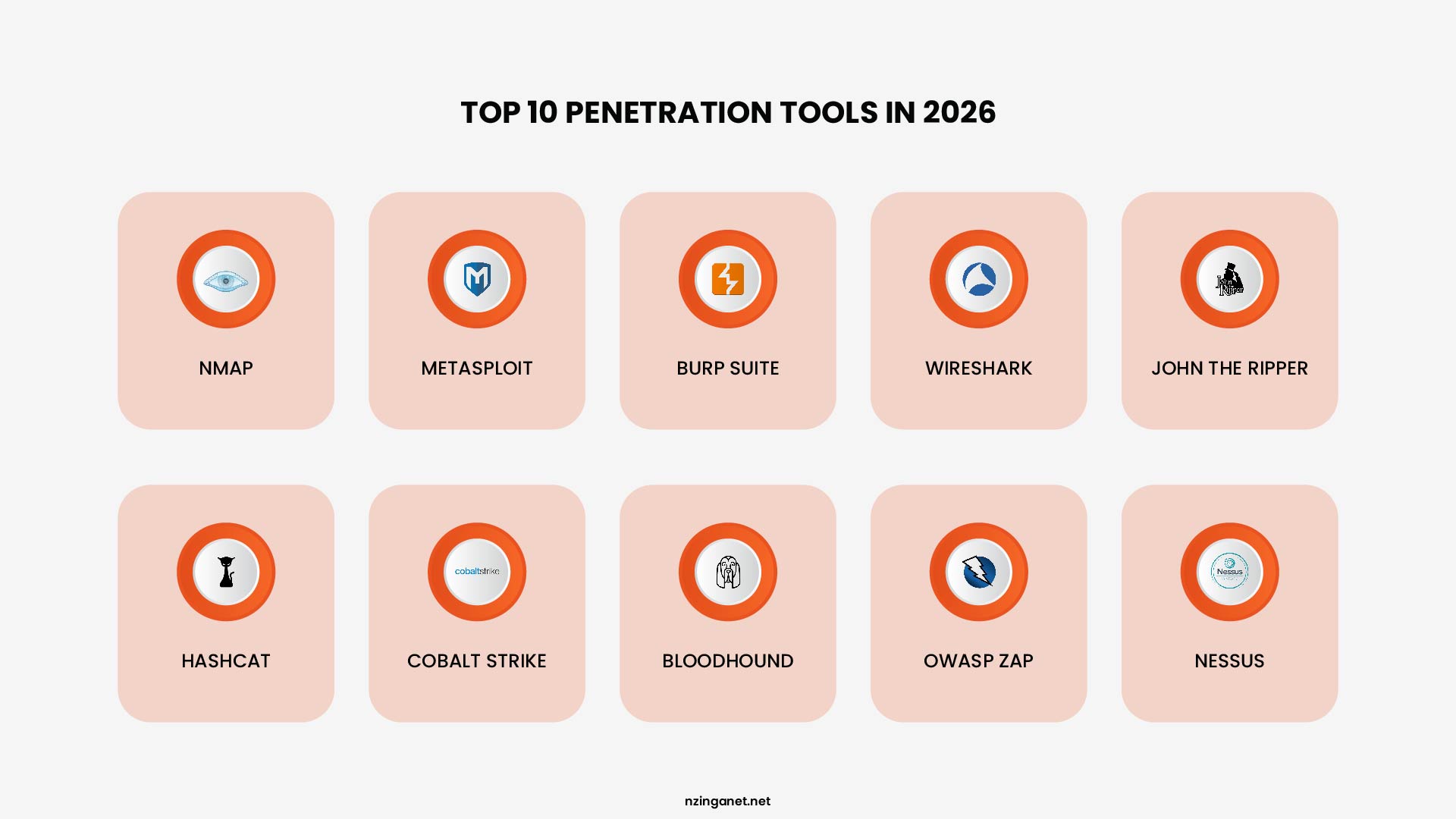
- Nmap is a network scanning tool that maps open ports and services across a network. It is one of the first tools a tester reaches for during reconnaissance and vulnerability identification.
- Metasploit is a penetration testing framework that contains a large library of known exploits for identified vulnerabilities. It significantly accelerates the exploitation phase by providing tested, reliable exploit code.
- Burp Suite is the dominant tool for web application testing. It acts as a proxy between the tester's browser and the target web application, capturing and modifying every request. It includes a scanner, a fuzzer, and a collection of tools for manually probing application logic.
- Wireshark captures and analyzes network traffic. Testers use it to look for unencrypted sensitive data, identify unusual traffic patterns, and understand how applications communicate.
- John the Ripper and Hashcat are password cracking tools. When testers obtain password hashes from a compromised system, these tools attempt to crack them using dictionaries, rules, and brute force techniques.
- Cobalt Strike is a commercial adversary simulation platform widely used for red team engagements. It provides capabilities for persistent access, command-and-control communication, and lateral movement that closely mimic what real advanced threat actors use.
- BloodHound maps Active Directory environments and visualizes attack paths through the network, showing which accounts and systems would allow an attacker to reach high-value targets like domain controllers.
- OWASP ZAP is an open-source web application scanner and testing proxy, similar in function to Burp Suite, widely used for web application assessments.
- Nessus is a widely used vulnerability scanner that helps identify known security issues across systems, applications, and network devices. It is commonly used during the vulnerability identification phase to quickly surface misconfigurations, missing patches, and known CVEs before manual validation.
PRICING
How Much Does Penetration Testing Cost?
Penetration testing cost varies widely depending on several factors: the scope and size of the engagement, the type of testing, the seniority of the testers, the depth of the assessment, and geographic location of the firm.
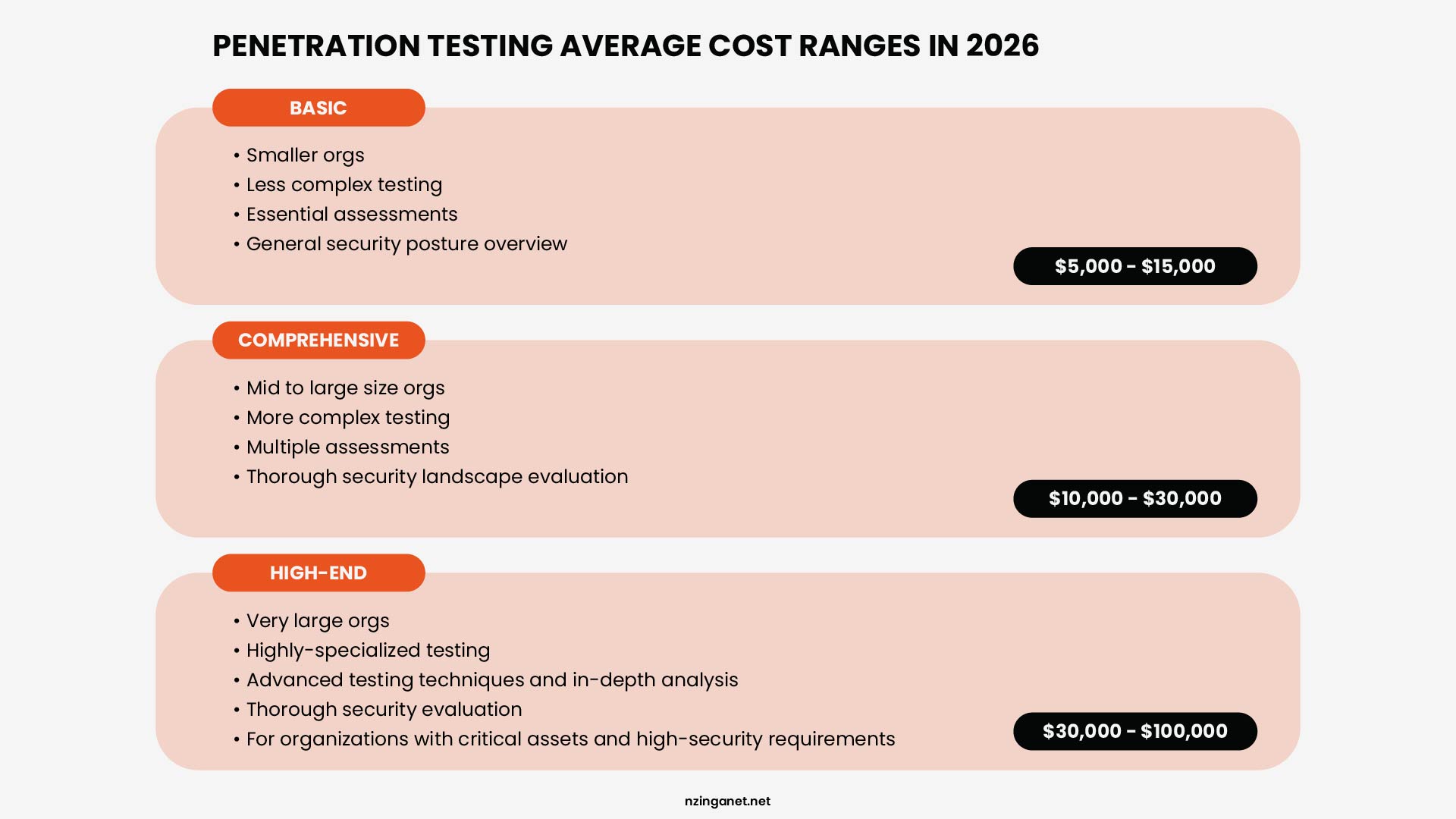
As a general range, here is what organizations can expect.
- A web application penetration test for a moderately complex application typically costs between $5,000 and $25,000. A simple application with a limited number of pages and functions works at the lower end. A complex application with multiple user roles, integrations, and a large feature set sits higher.
- A network penetration test for a small to medium-sized organization typically costs between $10,000 and $30,000 for an external assessment. Internal network testing or combined assessments cost more.
- A comprehensive red team engagement, which simulates a full attack campaign against an organization over an extended period, typically starts at $25,000 and frequently runs to $100,000 or more for large organizations.
- Social engineering tests as standalone engagements typically cost between $3,000 and $15,000 depending on the number of targets and the complexity of the scenarios.
Several factors push costs up: larger attack surfaces, more applications or systems in scope, more realistic and sophisticated testing approaches, compliance-driven reporting requirements, and faster turnaround times.
Some organizations reduce costs by narrowing scope to their highest-risk systems rather than testing everything, which is a reasonable approach when budget is limited, provided the scope is chosen thoughtfully based on actual risk.
It is worth noting that cheaper is rarely better in penetration testing. A low-cost test that runs automated scanning tools and repackages the output as a pen test report adds little value over what the organization could run internally. What makes pen testing valuable is skilled human analysis, creative thinking, and the ability to chain vulnerabilities together in ways no scanner can simulate. Paying for that expertise is what the investment actually buys.
How Often Should You Run a Penetration Test?
Annual penetration testing is the minimum for most organizations and is commonly required by compliance frameworks. Organizations that release new software frequently, operate in high-risk industries, or process sensitive data should test more often. Quarterly tests or tests tied to significant releases are appropriate for many software companies.
Any significant change to infrastructure or applications is also a trigger: a major new feature launch, a cloud migration, an acquisition, a significant architecture change, or a new integration with a third-party service.
Beyond scheduled testing, many mature security programs maintain a continuous element through bug bounty programs, where external researchers are invited to report vulnerabilities in exchange for rewards. Bug bounties complement but do not replace structured penetration testing.
What Should You Expect During a Pen Test?
Many companies go into their first penetration test with no idea what is about to happen. They worry that testers will break something important or that their employees will panic when they see unusual activity on their computers. A clear understanding of the process removes that uncertainty.
What the tester will and will not do
Denial of service attacks against production systems are typically out of scope for a standard penetration test. The tester is not trying to crash your servers or overwhelm your network with traffic. Instead, the tester is trying to understand whether they could cause a denial of service and whether they could reach sensitive data or systems if they did break through. Your contract will specify exactly which techniques are allowed and which ones are forbidden.
How communication works during the test
You should expect regular communication with the testing team throughout the engagement. The tester should send a daily update summarizing what they have tested, what they have found, and what they plan to test next. This keeps you informed without requiring you to monitor their activity in real time.
If the tester finds something critical, a good penetration testing firm flags it immediately rather than waiting for the final report. A critical finding might be a database server that is accessible from the internet with a default password or a domain controller that the tester can fully control within the first hour of testing.
An immediate notification gives your organization the opportunity to patch that critical flaw before the engagement even ends. You should ask your testing firm ahead of time how they define critical and how they will notify you.
What happens after the report is delivered
After the testing firm delivers the final report, you should expect a debrief call where the tester walks through each finding in detail. The tester will answer questions from your system administrators and developers about exactly what they did and how the organization can reproduce the issue on their own.
This call is also the right time to ask which findings you should fix first if you cannot fix everything at once. A good tester will give you a clear priority order based on which weaknesses are easiest to exploit and which ones lead to the most sensitive systems.
The debrief call should happen within a few days of report delivery while the findings are still fresh in the tester's mind. If the testing firm asks you to schedule the call three weeks later, you should push back or find a different firm.
Choosing a Penetration Testing Provider
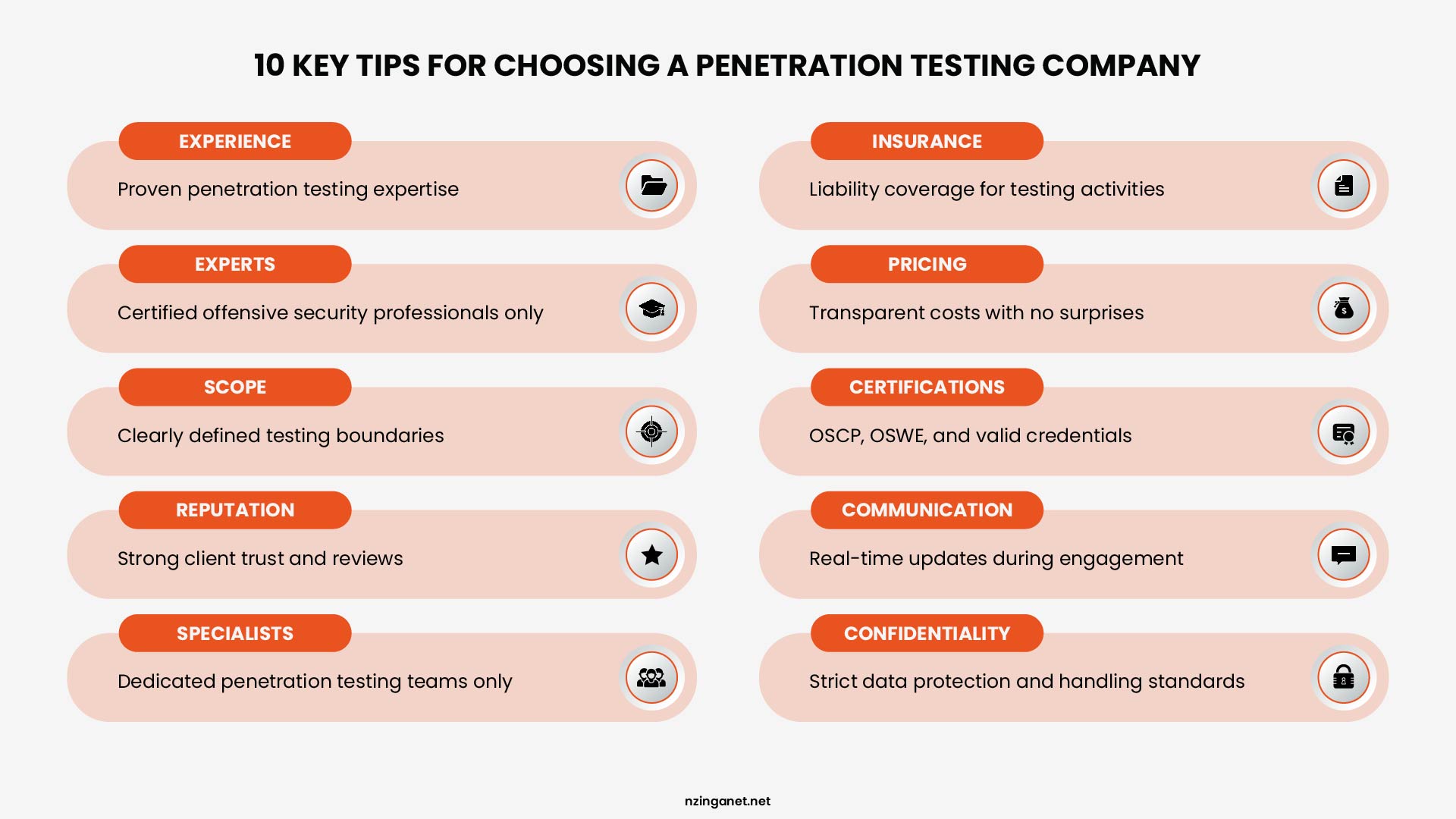
- Ask for the specific tester who will run your test: A firm is only as good as the person assigned to you, so you should know that person's name and credentials before you sign a contract. Look for an Offensive Security Certified Professional certification because it requires a hands-on exam where the candidate must be assigned to perform the tasks into systems. Avoid firms that assign junior staff with only multiple choice certifications because those credentials do not prove any practical hacking ability.
- Ask for a sample report before you sign: The report is the only thing you actually buy when you hire a testing firm, so you should see what you are paying for ahead of time. A good report includes screenshots of successful exploits and specific commands the tester ran to prove they actually broke into your systems. A bad report lists generic findings with no proof of human testing, which means the firm likely ran an automated scanner and formatted the output.
- Ask if the firm includes a free retest: You will fix the findings from your test, and then you will want to confirm that your fixes actually worked. Many firms charge extra for this confirmation, which can add thousands of dollars to your total expense. A good firm includes one retest within thirty to sixty days at no additional cost, and you should get this promise in writing before you sign the contract.
- Ask how the firm handles critical findings: A critical finding is something like a fully controllable server or accessible customer data that would cause a major breach if a real attacker found it. The firm should call you immediately when they discover something this serious so you can patch it before the test even ends. If the firm waits for the final report to tell you about critical findings, you should find a different provider who treats your risk with more urgency.
- Ask if the firm sells remediation services: Some SMBs consulting firms will test your systems and then offer to fix the problems they found for an additional fee. This arrangement creates a financial incentive for the testers to inflate their findings or to make problems sound worse than they really are. You should keep testing and remediation separate by hiring one firm to find the problems and a different team to fix them, or at minimum ask for a written policy that separates the testing team from the remediation team.
Red Team vs Pen Test: What Is the Difference?
| Feature | Penetration Testing | Red Teaming |
|---|---|---|
| Primary Goal | Identify and document technical vulnerabilities. | Measure overall security operations, detection, and response. |
| Scope | Usually narrow (e.g., a specific web app, network range, or cloud environment). | Broad, organization-wide (includes physical security, phishing, and third parties). |
| Stealth | High visibility; often loud to ensure all systems are checked. | Low visibility; aims to bypass EDR and evade detection. |
| Duration | Short, usually 1 to 2 weeks. | Extended, usually lasting several weeks or months. |
| Target Audience | IT and systems infrastructure. | The "Blue Team" (internal Security Operations Center). |
| Typical Cost | Starts around $30,000 depending on scope. | Starts around $40,000+ due to complex resources. |
Although both exercises simulate cyberattacks, they serve different purposes:
Penetration Testing (Pen Testing) focuses on identifying and exploiting specific technical vulnerabilities within defined systems or environments. The objective is to uncover security weaknesses, assess their impact, and provide actionable remediation guidance.
Red Teaming, by contrast, simulates a realistic adversary pursuing a predefined objective, such as gaining access to financial systems, compromising privileged accounts, or exfiltrating sensitive customer data. Red teams employ a wide range of attack techniques (including network exploitation, social engineering, phishing, and physical intrusion) while attempting to remain undetected throughout the engagement.
The goal of a red team exercise is not to find every vulnerability, but to determine whether the organization can effectively detect, investigate, and respond to a sophisticated attack. As a result, red teaming evaluates not only technical controls but also security monitoring, alerting processes, incident response procedures, and overall organizational resilience.
Red team engagements test not just technical controls but also the organization's detection, alerting, and incident response capabilities. They require more time, more experienced testers, and more budget, but they provide a more realistic picture of how the organization would fare against a determined adversary.
Because these engagements are more comprehensive and realistic, they typically require longer timelines, highly experienced operators, and larger budgets. However, they provide valuable insight into how an organization would perform against a determined and capable threat actor.
Turning Findings Into Action
A penetration test report is not the final objective; it is the starting point for strengthening an organization's security posture. The true value of a penetration test lies in how effectively the organization addresses and learns from the findings.
- The first step is to prioritize remediation efforts based on both the severity of the vulnerability and the potential business impact. Critical vulnerabilities that can be easily exploited should be addressed immediately, while lower-priority issues or findings that require significant architectural changes should be incorporated into a structured remediation roadmap.
- Organizations should also establish a formal remediation tracking process. Each finding should be assigned to a responsible owner, accompanied by a target resolution date, and monitored through regular status updates. Security and management teams should review progress consistently until all critical and high-risk issues have been resolved.
- Once remediation is complete, retesting is essential. Implementing a fix does not automatically guarantee that the vulnerability has been eliminated. A retest conducted by the original assessment team helps verify that the remediation was successful, confirms that no new weaknesses were introduced, and provides assurance that the risk has been effectively mitigated.
- Beyond addressing individual vulnerabilities, organizations should use the assessment results to improve their overall security program. Recurring patterns in findings often reveal broader weaknesses in areas such as secure development practices, patch management, configuration management, access controls, or employee security awareness. By addressing these root causes, organizations can reduce the likelihood of similar vulnerabilities appearing in the future and build a more resilient security posture.
Getting Started with Penetration Testing
If your organization has never conducted a penetration test, start by identifying your most critical assets. Consider where sensitive data is stored, which systems are essential to business operations, and which assets would have the greatest impact if compromised. Prioritizing these high-value targets ensures that testing efforts focus on the areas that matter most.
By understanding your most significant risks, you can make informed decisions about remediation, resource allocation, and future security investments.
If you're unsure where to begin, NzingaNet can help. Our security experts work with organizations to define the right testing scope, assess critical assets, and deliver actionable recommendations that strengthen security and reduce risk. Schedule a consultation with our team today.
COMMON QUESTIONS
Frequently Asked Questions
1. Does a penetration test guarantee that my organization is secure?
No. A penetration test provides a point-in-time assessment of the systems and applications within the agreed scope. New vulnerabilities can emerge as software changes, infrastructure evolves, and new threats are discovered. Penetration testing should be viewed as one component of a broader security program that includes continuous monitoring, vulnerability management, and security awareness training.
2. What should I prepare before a penetration test begins?
Organizations should ensure that all systems within scope are documented, key stakeholders are identified, and emergency contacts are available throughout the engagement. It is also important to define testing windows, communicate with internal teams when appropriate, and verify that backups and recovery procedures are in place before testing starts.
3. Will a penetration test identify insider threats?
A standard penetration test primarily focuses on external or technical attack paths. While some assessments evaluate privilege escalation and unauthorized internal access, detecting malicious insiders typically requires additional controls such as user activity monitoring, behavioral analytics, access reviews, and dedicated insider threat programs.
4. Can penetration testing help reduce cyber insurance costs?
Many cyber insurers now require evidence of security assessments before issuing or renewing policies. While a penetration test does not automatically lower premiums, demonstrating that vulnerabilities are regularly identified and remediated can strengthen an organization's risk profile and support cyber insurance applications and renewals.
5. What happens if critical vulnerabilities are discovered during the engagement?
Most reputable penetration testing firms follow an immediate notification process for critical findings. Rather than waiting for the final report, they alert designated contacts as soon as a severe issue is confirmed, allowing the organization to begin remediation while testing is still underway and reduce exposure to active threats.
PENNSYLVANIA & BEYOND
Ready to Find Out What an Attacker Would Find First?
NzingaNet provides penetration testing and broader cybersecurity consulting services to small and mid-sized businesses across Pennsylvania and the surrounding region, helping you uncover exploitable weaknesses before real attackers do.