May 11, 2026
The cloud was supposed to make IT simpler, and in some ways it has, but at scale, the complexity it introduces can quickly outpace the teams responsible for cloud infrastructure management.
Today, 73% of enterprises operate in hybrid cloud environments, juggling workloads across public clouds, private infrastructure, and everything in between, often without the unified visibility or governance needed to keep costs, performance, and security under control.
For IT professionals and managed service providers, this complexity in cloud infrastructure management represents a genuine business liability.
This guide unpacks what cloud infrastructure management actually involves, which tools are leading the market in 2026, and what best practices distinguish cloud environments that scale cleanly from those that gradually become unmanageable.
TABLE OF CONTENTS
- Key Takeaways
- What Is Cloud Infrastructure Management?
- Why Cloud Infrastructure Management Matters
- Key Components of Cloud Infrastructure Management
- What Are the Cloud Infrastructure Deployment Models?
- What Are Cloud Delivery Models in Cloud Computing?
- Best Cloud Infrastructure Management Tools in 2026
- How to Assess Your Cloud Infrastructure Management Needs
- Frequently Asked Questions
QUICK SUMMARY
Key Takeaways
- Cloud infrastructure management is the ongoing process of provisioning, monitoring, optimizing, and securing the compute, storage, networking, and services that power your cloud environment.
- The global cloud computing market reached $943 billion in 2025 and is on track to exceed $1 trillion in 2026. Over 94% of enterprises now use cloud in some form.
- The key components of cloud infrastructure are compute, storage, networking, databases, identity and access, security controls, monitoring, and automation. Managing all of them well requires intentional processes, not just tooling.
- Hybrid and multi-cloud architectures are now the dominant approach. By 2027, Gartner projects that 90% of organizations will use a mix of multiple clouds and on-premises infrastructure.
- Organizations waste an estimated 31% of their cloud spend on unused or oversized resources, according to Flexera. Cost optimization is now the top challenge for cloud teams.
- Infrastructure as Code (IaC), continuous monitoring, least-privilege access, and automated rightsizing are the foundational practices that separate well-managed cloud environments from ones that drift into waste and security risk.
DEFINITION
What Is Cloud Infrastructure Management?
Cloud infrastructure management is the set of processes, tools, and strategies used to configure, monitor, optimize, and secure cloud-based resources across computing environments. It covers everything from provisioning virtual machines and managing storage to enforcing security policies and controlling costs.
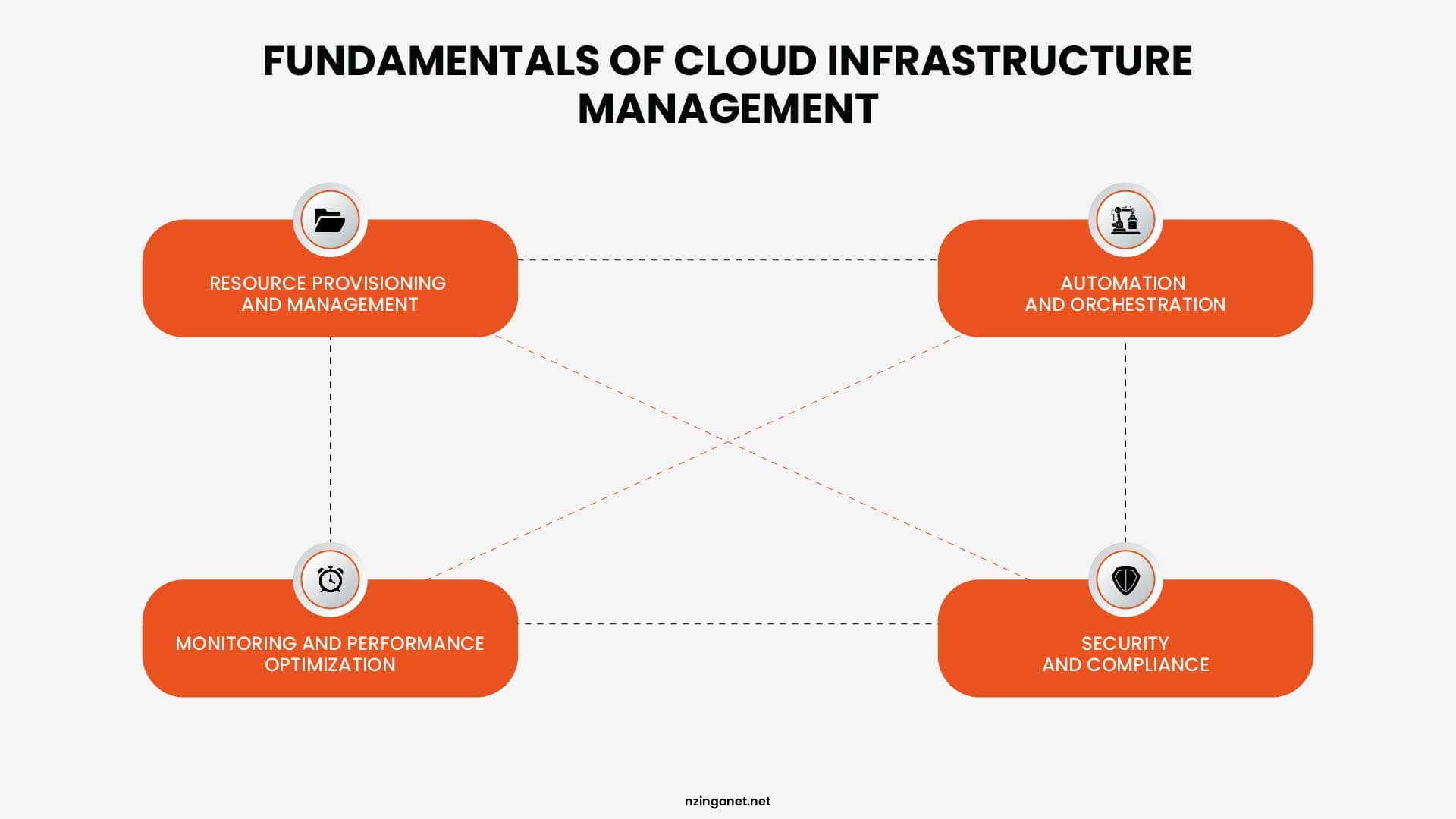
The four main building blocks that make cloud environments function are compute, storage, networking, and virtualization. Cloud infrastructure management connects all four into something you can actually govern.
Key aspects of cloud infrastructure management include:
- Resource Provisioning & Orchestration: Deploying and managing virtual machines, containers, and databases, often via infrastructure as code (IaC) to ensure consistency.
- Monitoring & Performance: Using tools to track resource utilization, maintain system health, and provide real-time insights for optimization.
- Cost Management & Optimization: Analyzing usage patterns to right-size resources, reduce waste, and manage pay-as-you-go costs.
- Security & Compliance: Enforcing security protocols, such as data encryption, IAM (Identity and Access Management), and ensuring adherence to regulatory standards like GDPR.
- Automation: Utilizing automation for routine tasks like backups, software updates, and scaling resources up or down based on demand.
IMPORTANCE
Why Cloud Infrastructure Management Matters
Every organization that has moved workloads to the cloud did so expecting outcomes: faster deployment, lower capital cost, better reliability, easier scaling. Whether those outcomes are realized depends almost entirely on how well the infrastructure is managed afterward. The cloud platform itself provides the raw capability. Management turns that capability into a consistent operational outcome.
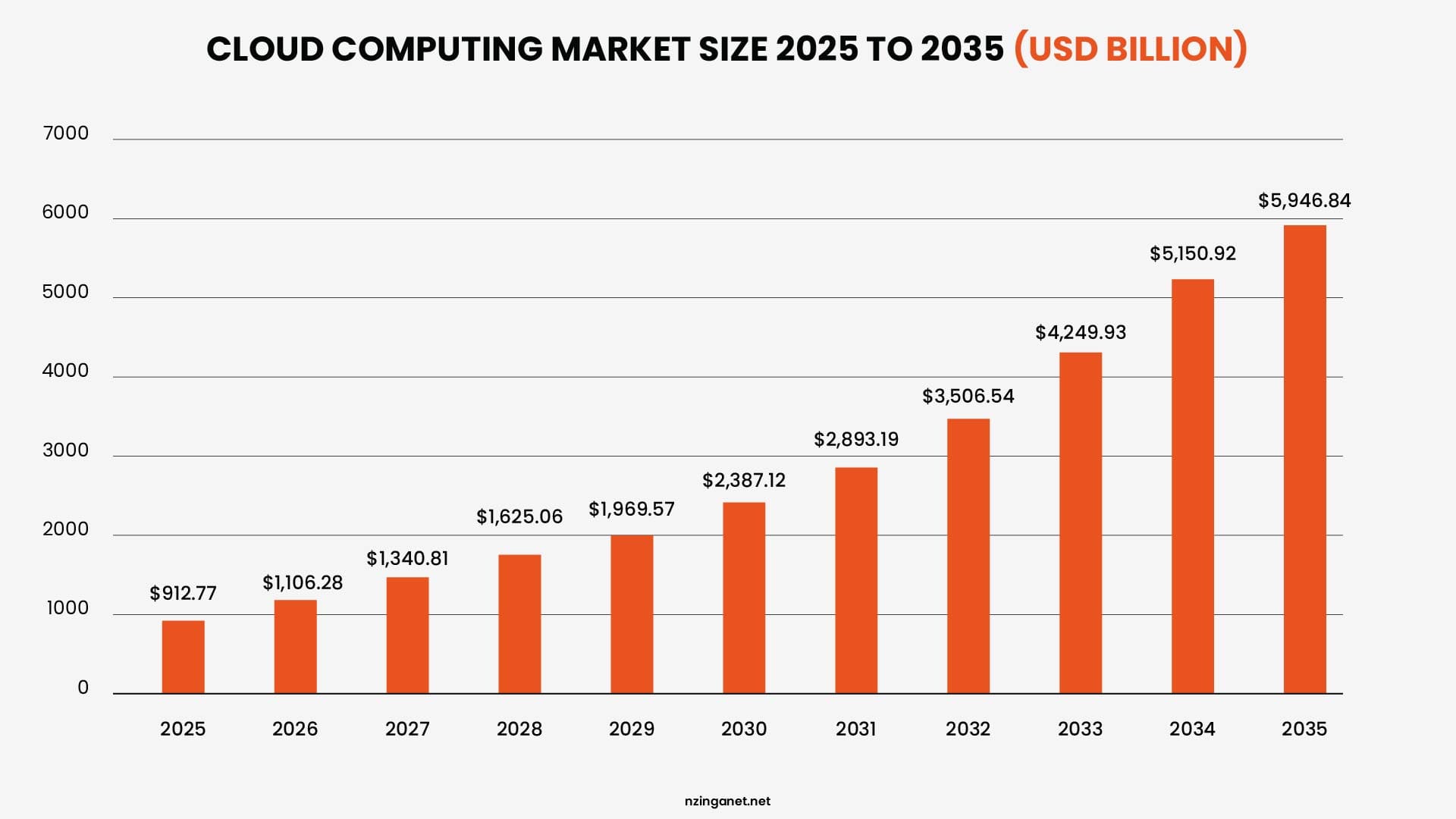
The scale of cloud adoption makes this management challenge large and growing. The global cloud computing market reached $943 billion in 2025 and will exceed $1 trillion in 2026, driven by AI workloads, data growth, and the near-universal shift of enterprise IT toward cloud-first strategies.
Over 90% of enterprises now use cloud in some form, and by 2026, analysts project that at least 45% of all enterprise IT spending will have shifted from traditional on‑premise systems to cloud‑based services.
COMPONENTS
Key Components of Cloud Infrastructure Management
Before getting into tools or strategy, it helps to understand what you're actually managing. Cloud infrastructure is made up of several distinct components, and each one requires its own approach.
Compute Infrastructure
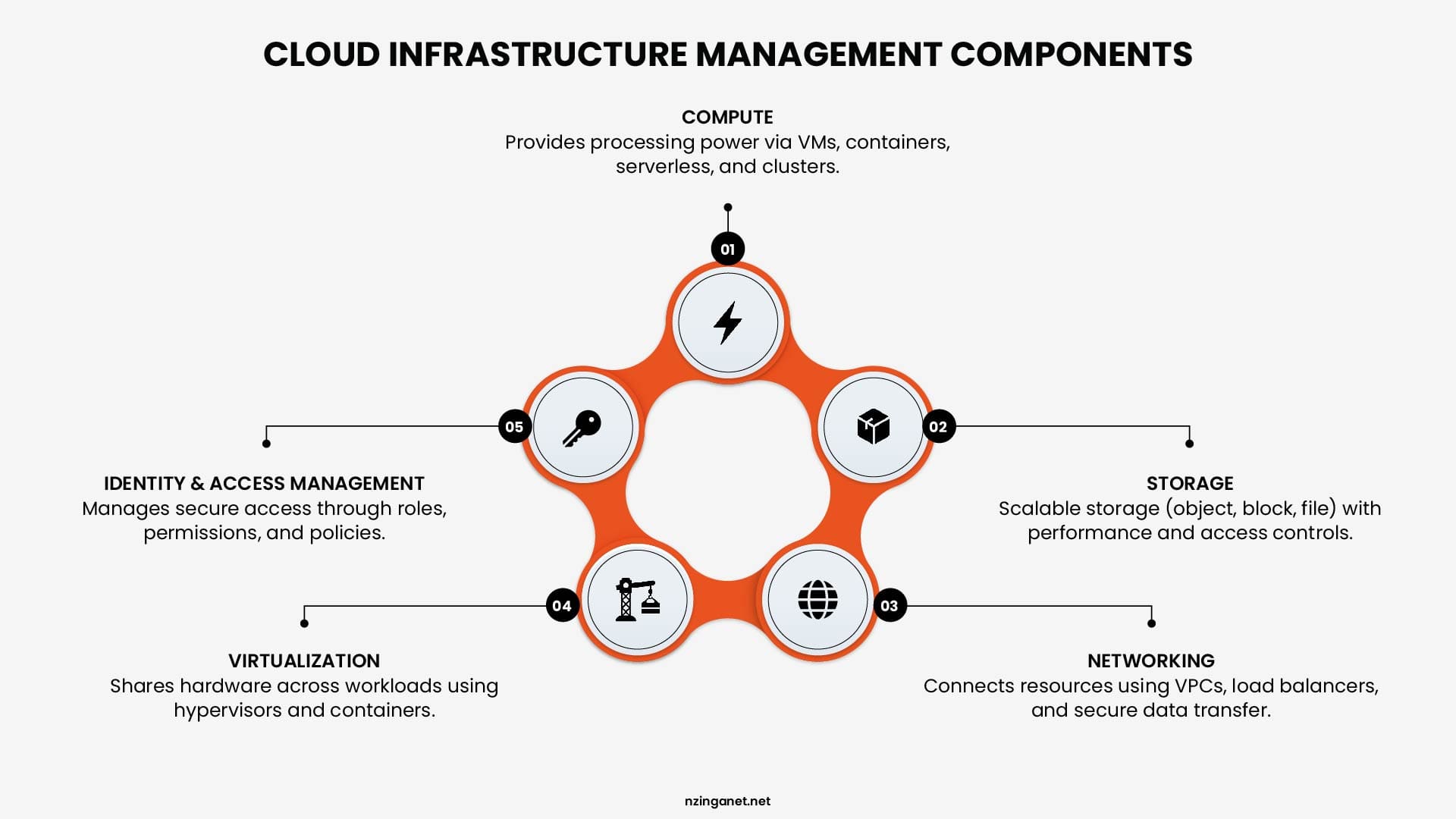
This is the processing power behind your workloads. It includes virtual machines, container services like Docker and Kubernetes, serverless functions like AWS Lambda or Azure Functions, and high-performance computing clusters. The right compute setup depends on what your applications actually need, not on what sounds modern.
Storage
Cloud storage comes in several forms: object storage for unstructured data (AWS S3 or Azure Blob), block storage for databases and applications requiring low latency, and file storage for shared access across multiple instances. Managing storage means balancing cost, performance, and data lifecycle policies.
Networking
This covers everything that moves data between your resources, including virtual private clouds (VPCs), load balancers, content delivery networks (CDNs), subnets, firewalls, and connectivity options like AWS Direct Connect or Azure ExpressRoute. Poor network management leads directly to latency problems, security gaps, and unexpected data egress costs.
Virtualization
Virtualization is what makes cloud scalability possible. It allows multiple virtual machines or containers to share physical hardware. Tools like VMware, Red Hat OpenShift, and Kubernetes enable workload portability and help organizations move applications between environments without rebuilding from scratch.
Identity and Access Management
Identity and Access Management (IAM) defines who and what can do which actions on which cloud resources. In cloud environments, IAM is not just an authentication system. It is a policy enforcement layer that determines whether a service account can write to a storage bucket, whether a developer can delete a production database, and whether an automated process can modify network configurations.
DEPLOYMENT MODELS
What Are the Cloud Infrastructure Deployment Models?
Most conversations about cloud infrastructure management assume you're on a public cloud like AWS, Azure, or Google Cloud. But the reality is more mixed.
According to a 2025 Rackspace State of Cloud Report surveying 1,420 IT professionals, 87% of global cloud decision-makers deploy workloads across public cloud, private cloud, and data center environments simultaneously.
Here's how each model breaks down:
| Model | What It Is | Strengths | Trade-offs |
|---|---|---|---|
| Public Cloud | AWS, Azure, Google Cloud provider-owned infrastructure accessible over the internet | Maximum scalability, pay-as-you-go, fastest time to provision | Less control over data location, shared physical infrastructure |
| Private Cloud | Infrastructure dedicated to one organization, hosted on-premises or in a third-party data center | Full control, stronger data sovereignty, predictable performance | Higher upfront cost, slower to scale, requires in-house management |
| Hybrid Cloud | Combination of public cloud and private infrastructure connected by a network | Flexibility to place workloads where they fit best, compliance and performance balance | More complex to manage, requires strong integration and governance |
| Multi-Cloud | Using multiple public cloud providers simultaneously for different workloads or redundancy | Avoids vendor lock-in, best-of-breed services, improved resilience | Increased management complexity, inconsistent tooling across providers |
Public Cloud Infrastructure
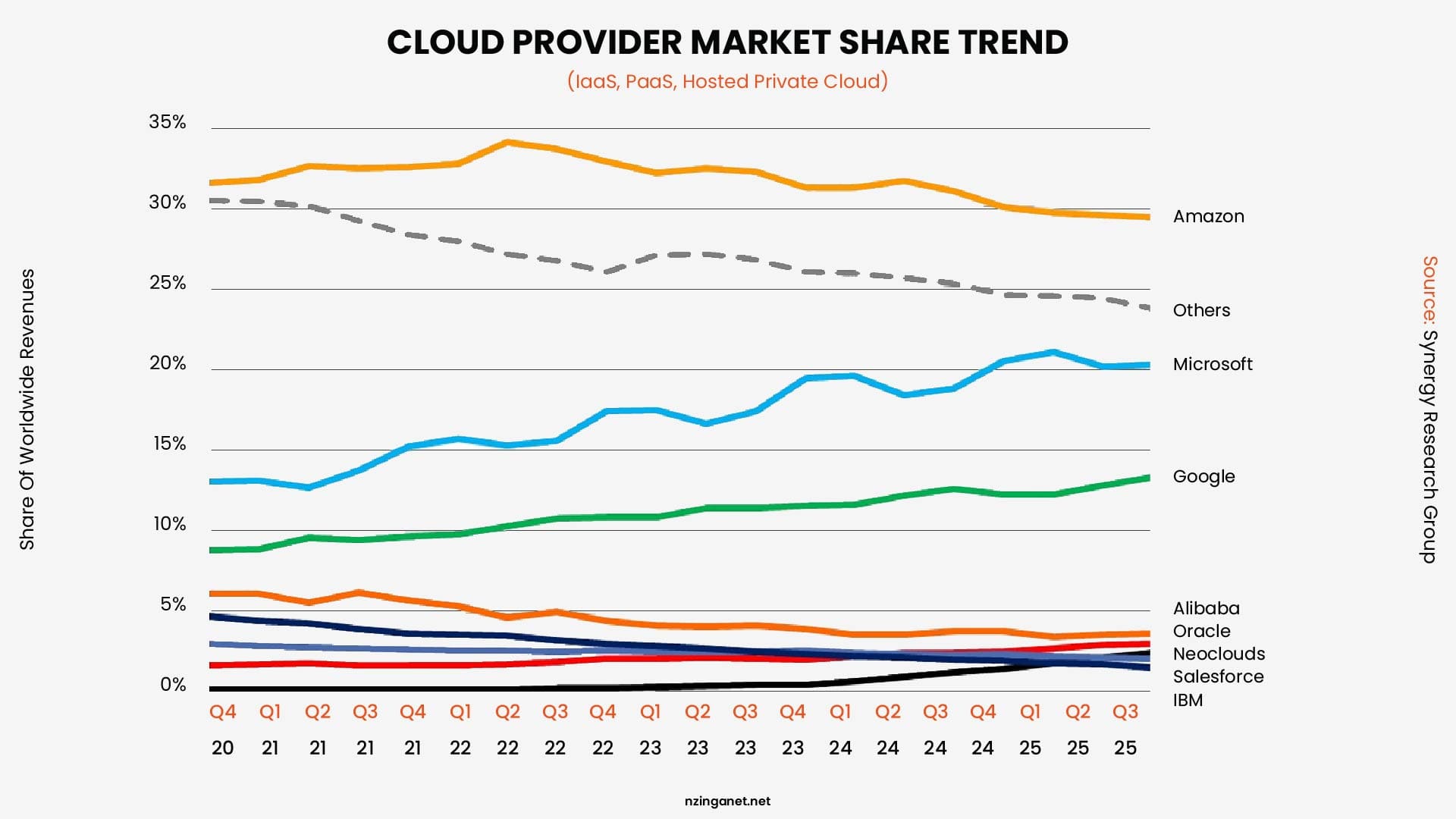
Public cloud is infrastructure owned and operated by a third-party provider like AWS, Azure, or Google Cloud. You consume resources on demand and pay for what you use. It's flexible, scalable, and relatively low effort to get started. AWS holds roughly 30% of the global cloud infrastructure market as of Q2 2025, Azure follows at 20%, and Google Cloud is at 13%, according to Synergy Research Group.
Public cloud offers the largest selection of managed services, the fastest provisioning timelines, and the most flexibility to scale capacity up or down in response to demand. The trade-off is that the underlying hardware is shared with other customers, and organizations have less visibility into the physical infrastructure beneath their workloads.
Private Cloud Infrastructure
Private cloud infrastructure is dedicated to a single organization. It may be hosted in the organization's own data centers or in a third-party colocation facility, but the hardware is not shared with other tenants. Private cloud provides stronger data isolation, more predictable performance, and greater control over data location, which matters for organizations in regulated industries or jurisdictions with strict data sovereignty and IT compliance requirements.
Hybrid Cloud Infrastructure
Hybrid cloud infrastructure management is the process of coordinating workloads, data, and security policies across both public cloud services and private on-premises systems. It enables organizations to operate these environments as a unified platform, rather than managing them separately. As a result, hybrid cloud has become the most widely adopted architecture in modern enterprises.
Multi-Cloud Management
Multi-cloud refers to the practice of using services from more than one public cloud provider simultaneously. An organization might use AWS for its compute workloads, Azure for its Microsoft 365 and Active Directory integration, and Google Cloud for its data analytics platform. This approach provides access to best-of-breed services from each provider, reduces dependence on any single vendor, and can improve resilience by distributing workloads across providers with separate infrastructure.
SERVICE MODELS
What Are Cloud Delivery Models in Cloud Computing?
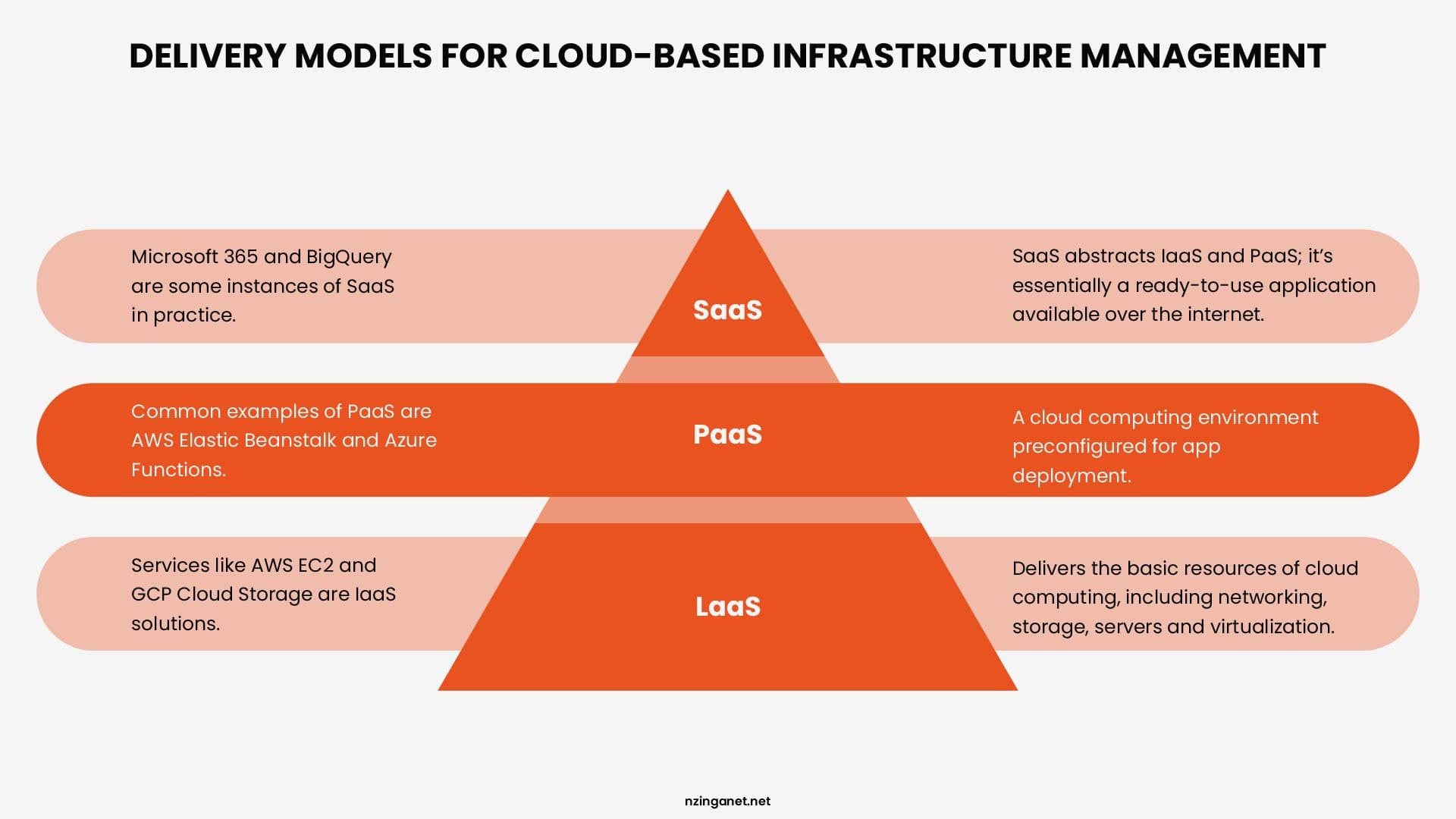
Cloud infrastructure management delivery models consist of three primary frameworks: Infrastructure as a Service (IaaS), Platform as a Service (PaaS), and Software as a Service (SaaS) which define the level of control and responsibility shared between the provider and the user. These models range from high-control infrastructure management to fully managed applications.
The Three Core Delivery Models
Infrastructure as a Service (IaaS)
IaaS is the most fundamental model. The provider delivers virtualized compute, storage, and networking over the internet. The customer is responsible for everything above the hypervisor: operating systems, middleware, runtime, applications, and data. IaaS offers maximum control and flexibility, making it the go-to choice for teams migrating on-premises workloads or running custom software stacks.
Examples: AWS EC2, Azure Virtual Machines, Google Compute Engine.
Platform as a Service (PaaS)
PaaS abstracts away the infrastructure layer. Developers deploy application code and data directly onto a managed environment, which literally means no OS patching, no server provisioning. The provider handles the runtime, middleware, OS, and hardware. PaaS dramatically accelerates software delivery but reduces low-level control.
Examples: Google App Engine, Heroku, Azure App Service.
Software as a Service (SaaS)
SaaS is the most abstracted model. The provider delivers a fully managed, ready-to-use application over the internet. The customer manages nothing except their own data and user access settings. SaaS is what most business users interact with daily.
Examples: Salesforce, Microsoft 365, Google Workspace.
Modern Delivery Model Variants
Containers as a Service (CaaS)
CaaS sits between IaaS and PaaS. The provider manages the container orchestration layer (typically Kubernetes), while customers package workloads in containers and deploy them without managing clusters. CaaS is ideal for microservices architectures. Examples: Amazon EKS, Google GKE, Azure AKS.
Function as a Service (FaaS) / Serverless
FaaS takes abstraction further. Customers deploy individual functions that execute on-demand in response to events. There are no servers to configure, no scaling rules to write: the infrastructure is entirely invisible. Billing is per invocation. Examples: AWS Lambda, Azure Functions, Google Cloud Run.
Hybrid and Multi-Cloud
Hybrid & Multi-cloud are deployment strategies rather than service types. Hybrid cloud combines on-premises infrastructure with one or more public clouds. Multi-cloud distributes workloads across multiple public cloud providers. Both approaches are common in enterprises with regulatory requirements, data residency constraints, or vendor diversification goals.
TOOLS
Best Cloud Infrastructure Management Tools in 2026
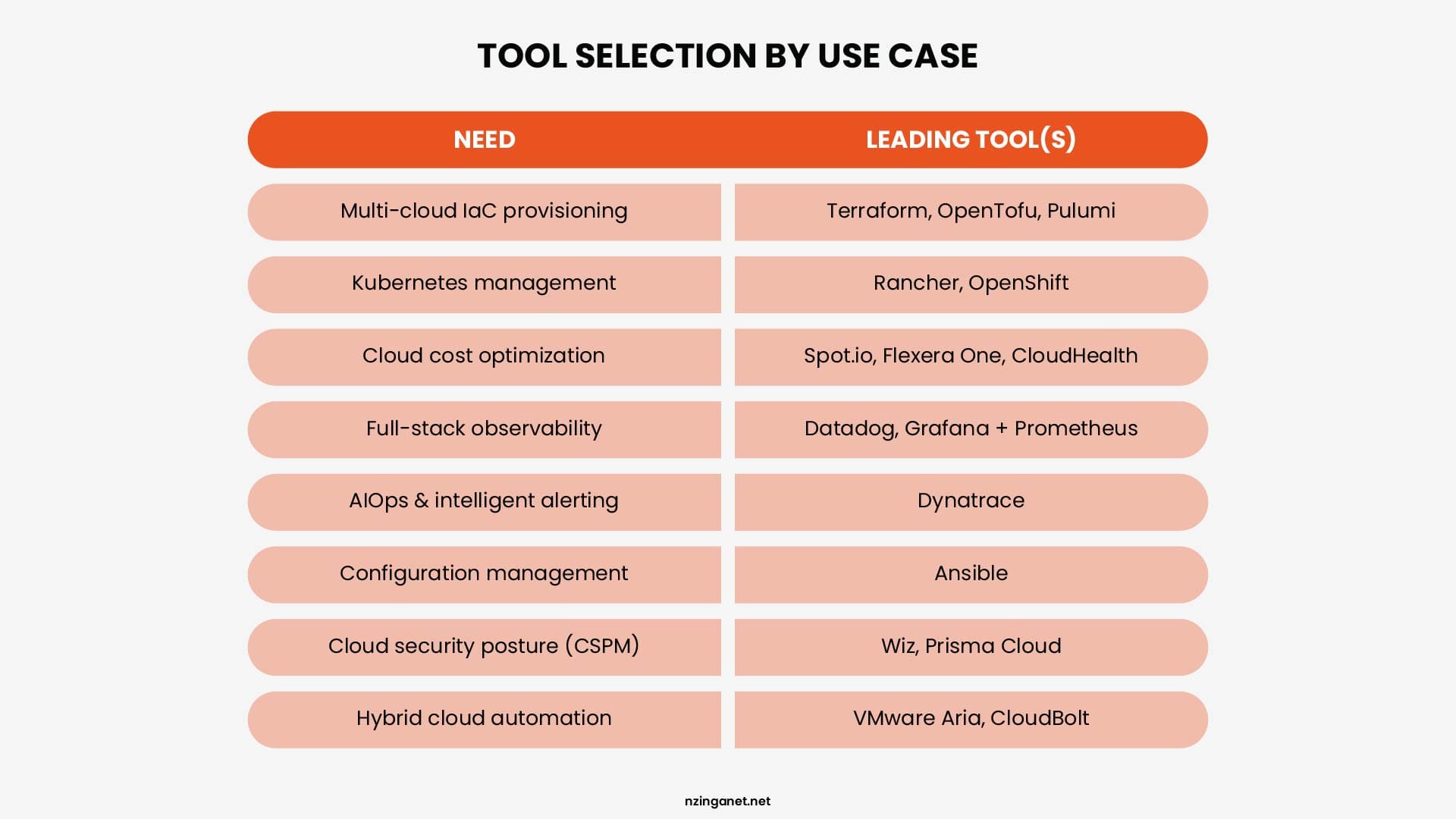
There are hundreds of options, and cloud infrastructure management has matured significantly. The tools below are the ones that actually dominate enterprise and mid-market environments in 2026, organized by category so you can match them to your specific management needs.
1. Infrastructure Provisioning & Automation
- Terraform (HashiCorp and IBM): Widely adopted infrastructure as code platform that uses declarative HCL syntax to provision and manage cloud resources across AWS, Azure and GCP. Offers a mature provider ecosystem, strong community support and Terraform Cloud for collaboration, state management and policy enforcement making it a default choice for multi-cloud provisioning at enterprise scale.
- OpenTofu: Open source infrastructure as code tool governed by the Linux Foundation and licensed under MPL, created as a fork of Terraform after the 2024 license change. Provides near-complete feature parity with Terraform, supports existing workflows and modules, and is now considered production ready for organizations seeking a fully open and vendor-neutral alternative.
- Pulumi: Modern infrastructure as code platform that allows developers to define cloud infrastructure using general purpose programming languages such as TypeScript, Python, Go and C#. Offers strong developer experience with reusable components, testing support and integrated AI assistance through Pulumi Copilot which increases productivity for cloud native and platform engineering teams.
2. Cloud Management Platforms (CMPs)
- VMware Aria: Enterprise grade cloud management suite designed for hybrid and multi-cloud environments providing capabilities for cost management, operations automation, governance and performance monitoring. Deep integration with the VMware ecosystem makes it a standard in large enterprises although recent pricing changes have encouraged some organizations to evaluate alternative platforms.
- Flexera One: Comprehensive cloud management and FinOps platform focused on cost optimization, usage visibility and software asset management across multiple cloud providers. Enables collaboration between finance, procurement and engineering teams with detailed reporting, budgeting and license compliance features that support large scale enterprise governance.
- CloudBolt: Hybrid cloud management platform that emphasizes automation, self-service provisioning and policy-driven governance for both on-premises and public cloud environments. Integrates with IT service management tools such as ServiceNow to standardize service delivery and improve operational efficiency across infrastructure teams.
3. Kubernetes & Container Orchestration Management
- Rancher (SUSE): Enterprise Kubernetes management platform that provides a centralized control plane for managing clusters across multiple environments including EKS, AKS, GKE and on-premises deployments. Offers role-based access control, policy enforcement and multi-tenancy features making it widely adopted for large-scale Kubernetes operations.
- Red Hat OpenShift: Comprehensive Kubernetes platform built for enterprise environments that includes integrated developer tools, CI/CD pipelines, security controls and lifecycle management. Strong alignment with the Red Hat ecosystem makes it a preferred choice for regulated industries and organizations requiring a complete application platform.
- Portainer: Lightweight container and Kubernetes management interface designed for smaller teams, edge deployments and environments that require simplicity over complexity. Provides an easy-to-use graphical interface for managing Docker and Kubernetes resources without the overhead of larger enterprise platforms.
4. Cloud Cost Management & FinOps
- AWS Cost Explorer, Azure Cost Management and GCP Cost Tools: Native cost management solutions provided by major cloud platforms offering basic visibility into usage, spending trends and budgeting within a single cloud environment. Suitable for organizations operating within one provider but limited in advanced optimization features and multi-cloud cost governance capabilities.
- CloudHealth by VMware: Cloud cost management and governance platform that delivers multi-cloud visibility, policy-based controls and optimization recommendations. Widely used by managed service providers and enterprises to enforce governance standards, track spending and improve financial accountability across cloud environments.
- Spot.io (NetApp): Cloud optimization platform focused on reducing compute costs by leveraging spot and preemptible instances with automated scaling and workload balancing. Products such as Ocean and Elastigroup enable organizations to achieve significant cost savings while maintaining application performance and reliability.
- Apptio Cloudability (IBM): Enterprise focused FinOps platform designed to provide detailed cost allocation, showback and chargeback capabilities across business units. Helps organizations align cloud spending with financial goals through advanced analytics, reporting and integration with broader IT financial management systems.
5. Monitoring, Observability & AIOps
- Datadog: Full-stack observability platform that provides infrastructure monitoring, application performance monitoring, log management, security insights and AI-driven root cause analysis. Extensive integrations and unified interface make it a leading choice for cloud native environments and modern DevOps teams.
- Grafana and Prometheus: Open source observability stack where Prometheus handles metrics collection and Grafana provides visualization dashboards and alerting capabilities. Offers flexibility, cost efficiency and strong community support with managed options like Grafana Cloud enabling easier deployment and scaling.
- Dynatrace: Advanced observability and AIOps platform that uses its Davis AI engine to deliver automated anomaly detection, root cause analysis and performance insights. Designed for large-scale enterprise environments requiring intelligent monitoring and reduced manual intervention in incident management.
- New Relic: Integrated observability platform that combines metrics, logs, traces and user experience monitoring into a single solution with a usage-based pricing model. Appeals to organizations looking for cost predictability and a unified monitoring experience without per-host pricing complexity.
6. Configuration Management & Drift Detection
- Ansible (Red Hat): Agentless configuration management tool that uses YAML-based playbooks to automate infrastructure provisioning, application deployment and system configuration. Popular across enterprises due to its simplicity, ease of learning and strong integration with Red Hat and hybrid environments.
- Chef Infra: Configuration management platform that uses a Ruby-based domain specific language to define infrastructure state and enforce consistency across systems. Maintains a presence in legacy enterprise environments with established workflows and long-term operational stability.
- Puppet: Declarative configuration management tool that automates system configuration, compliance and infrastructure lifecycle management. Known for its strong reporting capabilities and scalability in large environments although less common in new greenfield deployments.
- Pulumi ESC: Modern environment and secrets configuration solution that integrates tightly with Pulumi infrastructure workflows. Provides secure management of configuration data, secrets and environment variables enabling better control and consistency across cloud applications and services.
7. Security & Compliance Posture Management
- Wiz: Agentless cloud security platform that uses a graph-based approach to identify toxic combinations of risks across cloud environments. Rapid deployment, strong visibility and effective prioritization have made it a leading choice for new enterprise security adoption.
- Prisma Cloud: Comprehensive cloud security platform that provides capabilities across workload protection, application security, identity management and network security. Preferred by organizations seeking a single-vendor solution with broad coverage across multiple security domains.
- AWS Security Hub, Microsoft Defender for Cloud and Google Security Command Center: Native cloud security tools that provide baseline security posture management, threat detection and compliance monitoring within their respective cloud platforms. Commonly used as starting points and often integrated with third-party solutions for enhanced multi-cloud security visibility and control.
ASSESSMENT
How to Assess Your Cloud Infrastructure Management Needs
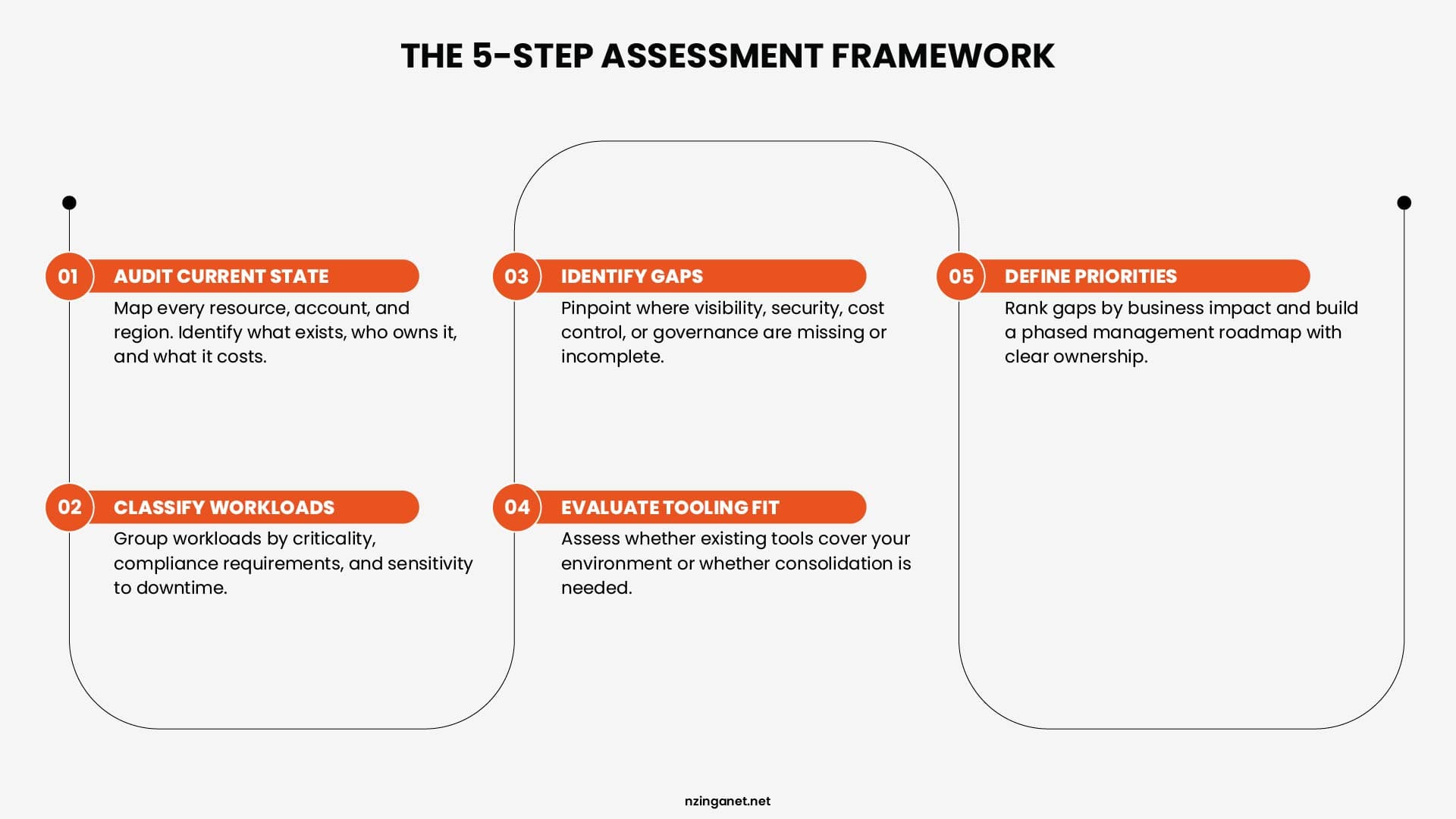
Before investing in new tools or processes, the most important question any IT team or managed service provider needs to answer honestly is this: what does your cloud environment actually look like right now, and where is it failing you?
- Start with your workload inventory. What are you running? Where is it running? What are the performance, availability, security, and compliance requirements for each workload? Most teams are surprised by how many resources they have running that nobody is clearly responsible for.
- Then assess your current tooling. Are you monitoring effectively? Do you have centralized visibility into cost and security posture? Are deployments manual or automated? Do you have documented recovery procedures?
- After that, identify your top three pain points. Cost overruns, security incidents, deployment complexity, lack of visibility, and slow incident response are the most common. Knowing your actual pain points lets you prioritize tool investment and process improvement rather than adopting everything at once.
- Finally, align on your workload placement strategy. Which workloads belong on the public cloud? Which need to stay on private infrastructure for regulatory or latency reasons? Which benefits from a hybrid approach? This strategic alignment, before you start provisioning, prevents the kind of technical debt that costs teams months to unwind.
Make Cloud Solutions Simple with NzingaNet
Cloud infrastructure management can feel overwhelming, such as sprawling environments, rising costs, security gaps, and teams stretched thin across too many tools and too many decisions.
NzingaNet helps businesses take control of their cloud environments without the complexity. Whether you are just beginning your cloud journey, optimizing an existing multi-cloud setup, or trying to bring costs and compliance back under control.
If any part of this guide raised questions about your own cloud environment, that is a good place to start.
COMMON QUESTIONS
Frequently Asked Questions
1. What is cloud infrastructure management?
Cloud infrastructure management is the continuous process of provisioning, configuring, monitoring, optimizing, and securing the compute, storage, networking, and services that make up a cloud environment. It ensures that cloud resources are performing as expected, costs are controlled, security policies are enforced, and the infrastructure can scale to meet changing demand.
2. What are the main components of cloud computing infrastructure?
The main components are compute (virtual machines, containers, serverless functions), storage (object, block, and file storage with multiple performance tiers), networking (VPCs, load balancers, CDNs, private connectivity), databases (relational, NoSQL, and in-memory), identity and access management, security controls, monitoring and observability, and automation tooling. Managing all of these components effectively requires intentional processes and the right tooling for each layer.
3. What is the difference between public, private, and hybrid cloud?
Public cloud infrastructure is owned by a cloud provider and accessed over the internet on a consumption basis. Private cloud infrastructure is dedicated to one organization and provides stronger data isolation and control. Hybrid cloud combines public and private infrastructure, allowing organizations to place workloads in the environment that best suits their specific requirements for performance, compliance, and cost.
4. What are the best cloud infrastructure management tools?
The most important tool categories are Infrastructure as Code (Terraform, Pulumi, CloudFormation), container orchestration (Kubernetes and its managed variants), monitoring and observability (Datadog, Grafana, CloudWatch, Azure Monitor), cost management (AWS Cost Explorer, Azure Cost Management, CloudHealth, Spot.io), and secrets management (HashiCorp Vault, cloud-native KMS services). Most mature cloud environments use tools from all of these categories working together.
5. How do organizations reduce cloud infrastructure costs?
The most effective cost reduction practices are rightsizing instances based on actual utilization data, using reserved pricing or savings plans for stable workloads, automatically stopping non-production resources outside business hours, enforcing resource tagging to identify and decommission unused resources, and using spot or preemptible instances for fault-tolerant batch workloads. Organizations that apply these practices consistently can typically reduce cloud spend by 20 to 40 percent compared to unmanaged environments.
6. What is hybrid cloud infrastructure management?
Hybrid cloud infrastructure management is the practice of coordinating and governing workloads, data, security policies, and costs across a combination of public cloud and private on-premises infrastructure. It requires unified management tooling, consistent policy enforcement across environments, reliable network connectivity, and integrated cost visibility that captures both cloud consumption charges and on-premises infrastructure costs.
PENNSYLVANIA & BEYOND
Stop Cybersecurity Threats Before They Cost You: NzingaNet Can Help
NzingaNet provides managed IT and cybersecurity services to small and mid-sized businesses across Pennsylvania and the surrounding region. From endpoint protection to compliance readiness, we handle the security so you can focus on your business.