July 20, 2026
Vishing is a form of cyber attack where criminals use phone calls or voice messages to trick people into revealing sensitive information. The term combines "voice" with "phishing," and it has become one of the fastest-growing threats in cyber security.
Voice phishing incidents increased 442% in Q2 of 2024 alone, and the trend has continued through 2026. Attackers are using AI voice cloning, caller ID spoofing, and sophisticated social engineering to target everyone from individual consumers to C-suite executives.
Unlike email phishing, where a suspicious message is sent to your inbox for you to examine, vishing happens in real time. The attacker is on the line, responding to your questions, adjusting their story, and creating pressure that makes it difficult to think clearly. This immediacy is what makes vishing so effective and dangerous.
TABLE OF CONTENTS
- What Is Vishing? A Clear Definition
- How Vishing Attacks Work
- Common Types of Vishing Attacks
- Some Real-World Vishing Attack Examples
- Phishing vs Vishing vs Smishing: Key Differences
- How to Prevent Vishing Attacks
- What to Do If You Are a Vishing Victim
- Staying Ahead of Vishing Attacks
- Frequently Asked Questions
Main Highlights
- Vishing attacks happen in real time, letting attackers hear your voice, adjust their story, and pressure you in ways email phishing cannot. Voice phishing incidents increased 442% in Q2 of 2024 alone, and more than two-thirds of Americans now receive at least one scam call every week.
- Attackers impersonate banks, government agencies, tech support, executives, and IT help desks, using AI voice cloning, caller ID spoofing, and urgency to convince victims to hand over credentials, one-time codes, or wire transfers.
- High-profile breaches at MGM Resorts and Caesars Entertainment both began with a single vishing call to an IT help desk, showing how one phone call can lead to millions of dollars in losses and weeks of downtime.
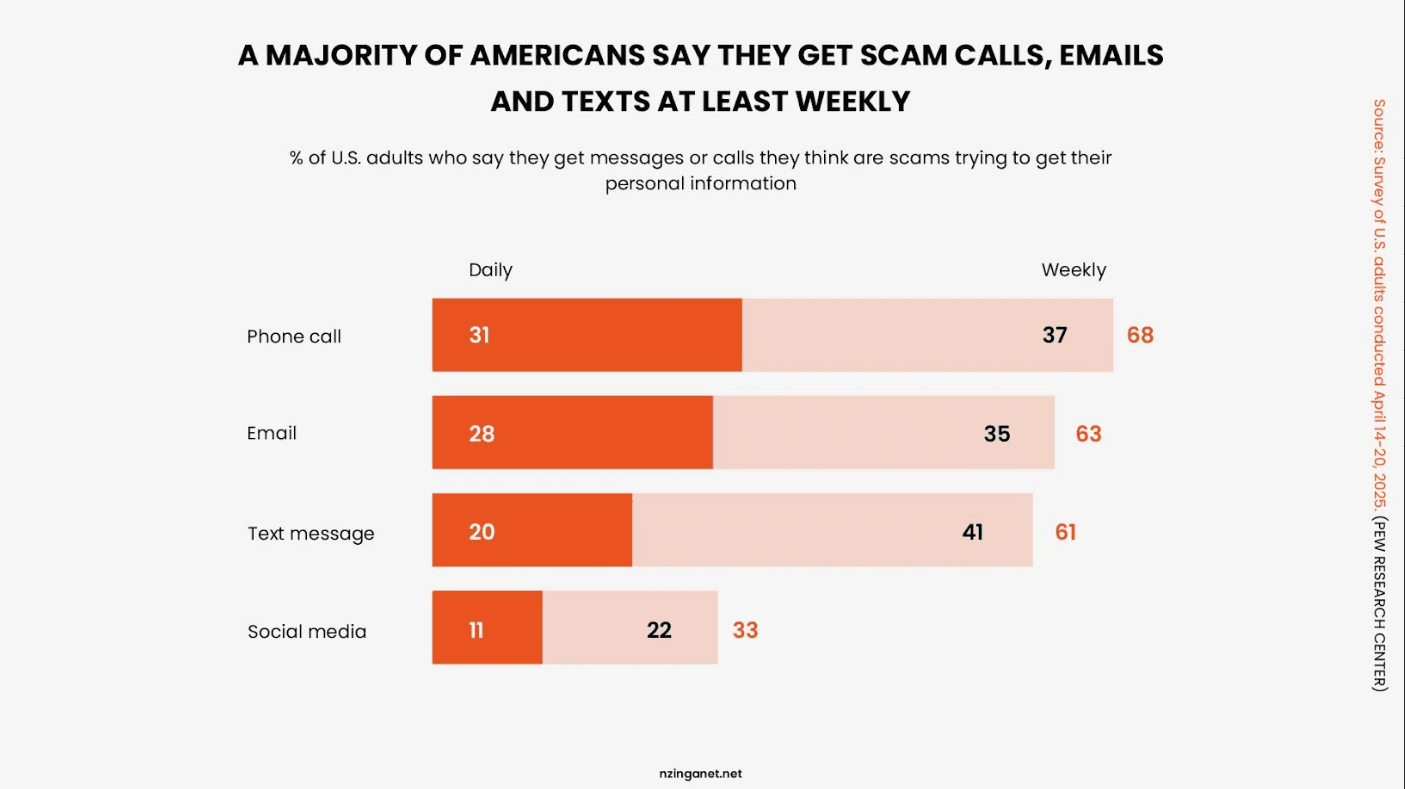
The scale of the problem is reflected in the number of scam calls people receive every day. According to Pew Research, more than two-thirds of Americans receive at least one scam call each week, while 31% report receiving scam calls daily. An additional 21% say they are targeted several times per day.
Given how common scam calls have become, it's important to understand the tactics behind them. While not every scam call is a vishing attempt, many are designed to steal personal information, financial data, or account credentials through manipulation and impersonation. Understanding how these attacks work is essential for recognizing and avoiding them.
This guide explains what vishing is, how it works, the most common attack types, real-world examples, and actionable prevention strategies for individuals and organizations.
What Is Vishing? A Clear Definition
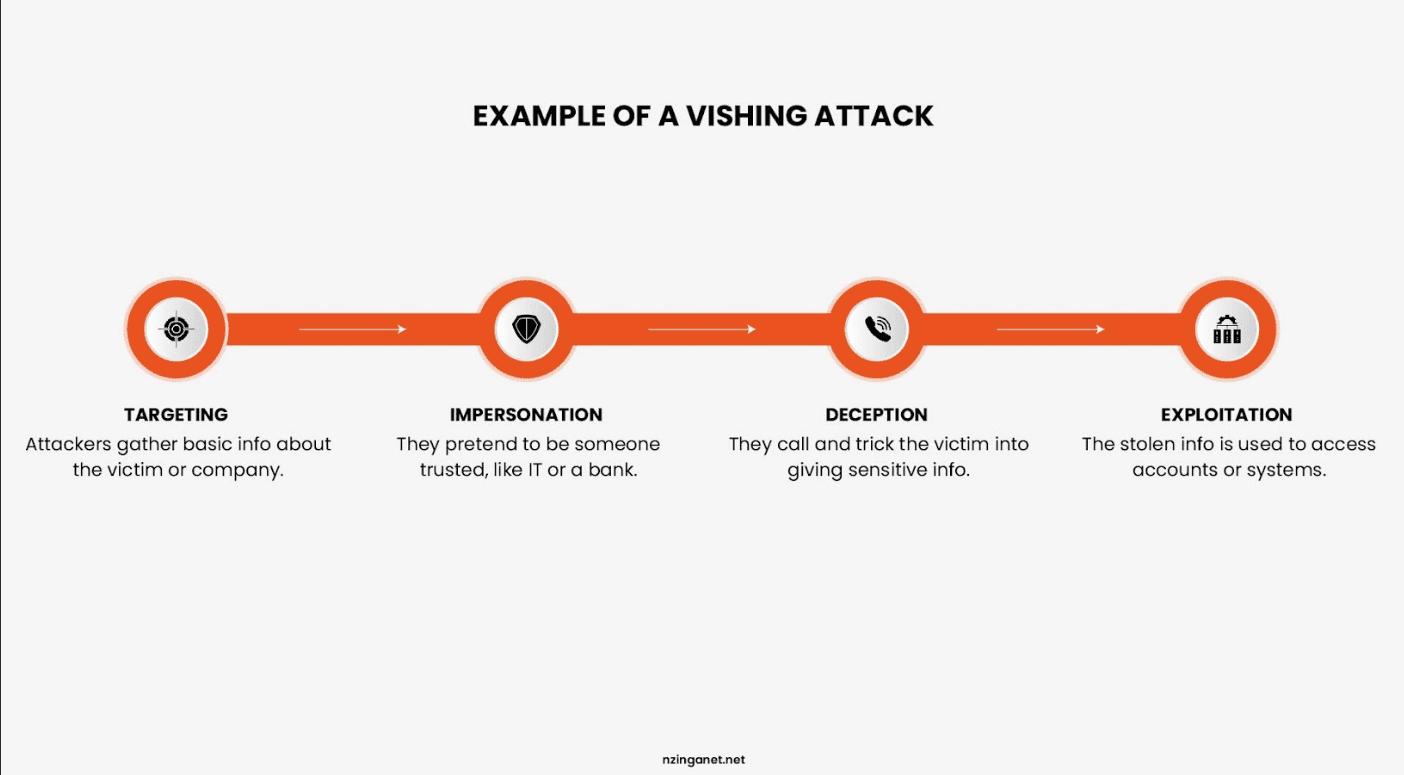
Vishing (voice phishing) is a type of cyber attack where criminals use telephone calls, VoIP systems, or voice messages to deceive individuals into revealing confidential information. This includes login credentials, banking details, social security numbers, credit card information, and one-time passcodes.
Unlike a traditional phishing email that tries to trick you into clicking a malicious link, a vishing attack happens in real time through conversation. The attacker can hear your voice, answer your questions, adjust their story based on your responses, and create pressure that feels immediate and real.
Attackers typically pretend to be from legitimate organizations. Your bank. The IRS. Social Security Administration. Tech support from Microsoft or Apple. A government agency. Your company's IT department. Even your own CEO.
Why Is It Called Vishing?
The word "vishing" combines "voice" and "phishing." Security researchers created the term to describe phishing attack surfaces delivered through voice communication instead of email. The goal is the same: convince someone to take an action they would not take if they had more time and context.
How Vishing Attacks Work
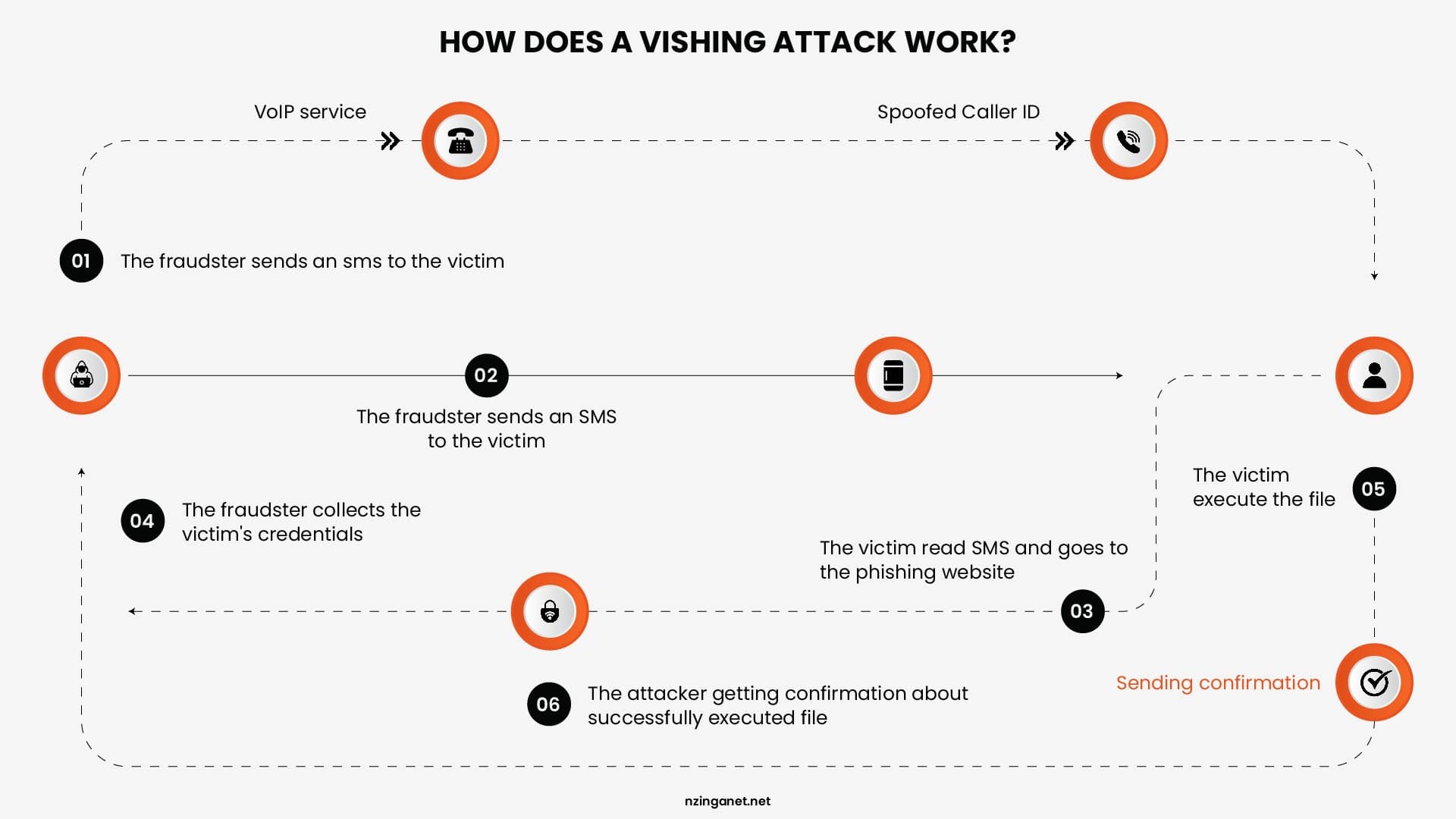
Understanding the mechanics of a vishing attack is the first step to protecting yourself. Most vishing attacks follow a similar pattern, though sophistication varies widely.
The Basic Structure of a Vishing Attack
A typical vishing attack unfolds in five stages.
- Stage 1: The attacker chooses a believable role. They may pose as a bank representative, IT support technician, government agent, vendor, customer, or company executive. The role is chosen based on who the victim is likely to trust.
- Stage 2: The call creates a reason to act. The attacker claims there is fraud on your account, a deadline approaching, a failed payment, a security breach, or another urgent problem requiring immediate attention.
- Stage 3: The attacker keeps you engaged. They ask questions, confirm details, give instructions, and discourage you from pausing to think or verify anything. The longer you stay on the call, the more likely you are to comply.
- Stage 4: Sensitive information is requested. The caller asks for login credentials, one-time codes, account numbers, social security numbers, payment information, or remote access to your computer.
- Stage 5: The call becomes part of a larger attack. The voice contact may be combined with emails, text messages, fake websites, or follow-up calls to make the entire story feel consistent and believable.
The Psychology Behind Vishing
Vishing works because it exploits basic human emotions and cognitive biases.
- Fear. Attackers threaten legal action, arrest, account closure, or financial loss. Fear shuts down rational thinking. When someone tells you the IRS is about to arrest you, your brain focuses on the threat, not on verifying who is calling.
- Urgency. "You must act now or it will be too late." This prevents victims from taking the time to verify the caller's identity or think through the request logically.
- Authority. Attackers claim to be from positions of authority: bank fraud departments, government agencies, law enforcement, or corporate executives. People are conditioned to follow instructions from authority figures.
- Trust. By spoofing caller IDs and using personal information gathered from data breaches, attackers make themselves seem trustworthy. If the caller ID says "Bank of America" and they know your name and address, you are more likely to believe them.
Common Types of Vishing Attacks
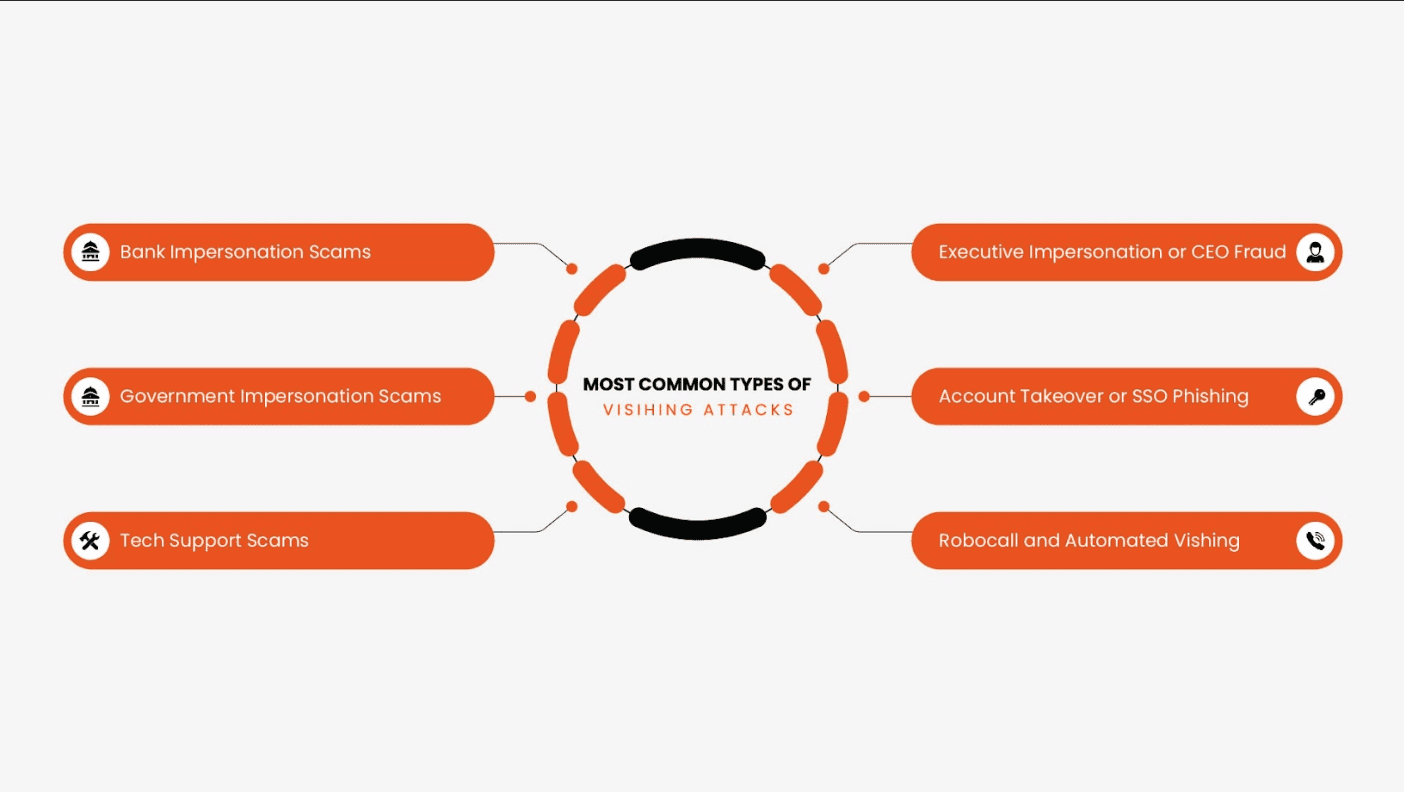
Vishing attacks take many forms. Each type targets a different vulnerability, but all rely on impersonation and psychological manipulation.
1. Bank Impersonation Scams
Attackers call claiming to be from your bank's fraud department. They say suspicious charges have appeared on your account and they need you to verify your identity by sharing your account number, PIN, or a security code sent to your phone.
The goal is to extract bank credentials or bypass two-factor authentication. The tactic relies on impersonation plus urgency. Legitimate banks already have your account information. They do not need you to verify it over an unsolicited phone call.
2. Government Impersonation Scams
Scammers call saying you owe back taxes or there is a problem with your social security number. They threaten arrest, deportation, or legal action if you do not pay immediately. They often demand payment through unconventional methods like gift cards, wire transfers, or cryptocurrency.
The goal is to steal money directly. The tactic relies on fear and coercion. The IRS does not make initial contact by phone. They send letters through the mail. They never demand immediate payment over the phone or threaten arrest.
3. Tech Support Scams
Attackers, posing as technicians from Microsoft, Apple, or major cybersecurity firms, call to say your computer has been infected with a virus or compromised by hackers. They request remote access to your computer to fix the problem.
The goal is to install malware, steal data, or gain access to your network. The tactic relies on authority and technical confusion. Legitimate tech companies do not make unsolicited calls to fix your computer. If there is a real problem, you will see error messages or notifications within your software.
4. Executive Impersonation or CEO Fraud
This sophisticated attack targets corporate employees. Attackers use AI voice cloning to impersonate the CEO or another executive. They call the CFO or another senior employee and claim there is an urgent, confidential acquisition or payment that needs to be processed immediately. They insist on discretion due to "insider trading concerns" or "sensitive negotiations."
The goal is to initiate fraudulent wire transfers. The tactic relies on authority, trust, and urgency. In one experiment with 240 participants, 68.3% believed their interactions with an AI phishing bot were real, and the bot managed to extract sensitive information from 52% of participants.
5. Account Takeover or SSO Phishing
In early 2026, Okta warned about custom phishing kits designed specifically for vishing attacks targeting single sign-on credentials. Attackers call employees, impersonate IT staff, and offer to help set up passkeys or resolve a login issue. They trick the victim into visiting a phishing site that captures their SSO credentials and one-time passcodes in real time.
Once the attacker has access, they log into the company's Okta dashboard and gain access to every connected platform: Microsoft 365, Google Workspace, Salesforce, Slack, Zoom, and more. They then steal sensitive customer data and demand ransom.
6. Robocall and Automated Vishing
These attacks use automated voice systems to deliver pre-recorded messages. The message typically claims there is a problem with your account, a warrant for your arrest, or an urgent tax matter. It instructs you to press a number or call back a specific phone number to resolve the issue.
The goal is to connect you with a live attacker or steal information through an automated system. The tactic relies on volume. Robocall systems can dial thousands of numbers per hour, making them efficient for attackers.
Some Real-World Vishing Attack Examples
To understand the real-world impact of vishing, it's helpful to examine how these attacks have been used against both individuals and large organizations. The examples below demonstrate how a single phone call can lead to credential theft, unauthorized system access, data breaches, and multimillion-dollar losses.
Morgan Stanley Wealth Management Vishing Campaign
In February 2022, Morgan Stanley Wealth Management clients were targeted in a caller impersonation vishing campaign. Hackers impersonated Morgan Stanley employees and called wealth management clients, duping them into disclosing login credentials. Unlike IT-helpdesk vishing, this targeted end customers directly.
The MGM Resorts Ransomware Attack
In September 2023, the hacker group Scattered Spider (later allied with ALPHV/BlackCat ransomware) conducted a vishing attack on MGM Resorts. Attackers found an MGM employee on LinkedIn, impersonated them, and called the corporate IT help desk. They convinced help desk staff to reset credentials and grant remote access. This bypassed security controls and gave attackers administrator access to Okta and Azure, enabling ransomware deployment. The attack shut down casino operations for 10 days, compromised 37 million guest accounts, and cost MGM approximately $100 million in lost revenue and recovery costs.
Caesars Entertainment Ransomware Attack
Shortly before MGM's breach (also September 2023), Caesars Entertainment fell victim to a similar vishing attack. Hackers tricked Caesars' IT help desk into resetting a password for someone claiming to be an employee, granting access to Caesars' systems. The attack was also attributed to Scattered Spider/ALPHV.
Phishing vs Vishing vs Smishing: Key Differences
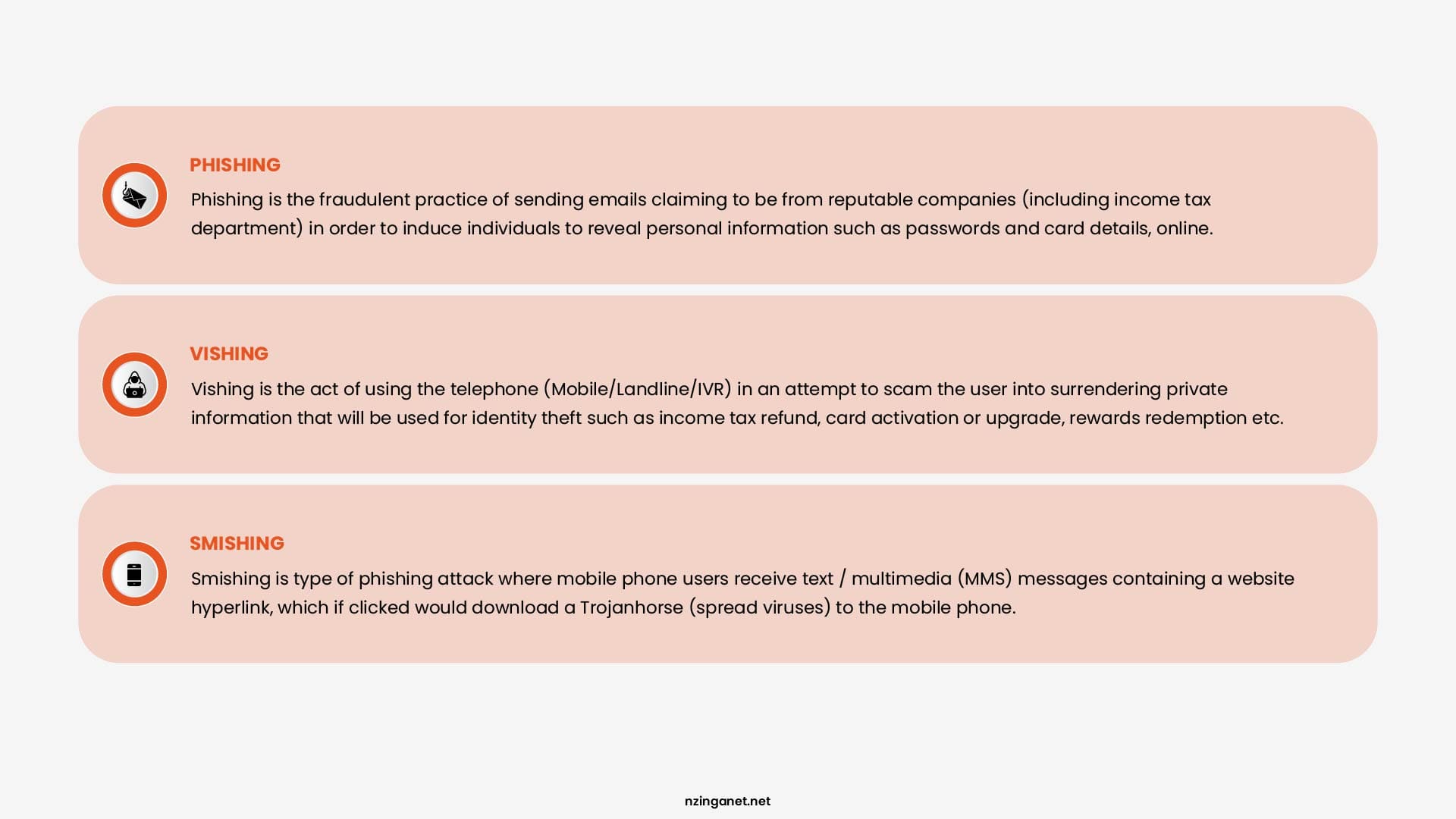
Phishing, vishing, and smishing are all social engineering attacks. The difference is the communication method and how the attack is delivered.
| Attack Type | Communication Method | Key Tactic | Detection Difficulty |
|---|---|---|---|
| Phishing | Malicious links and attachments | Moderate (email filters help) | |
| Vishing | Phone calls, VoIP, voicemail | Human manipulation, urgency, fear | High (voice is harder to filter) |
| Smishing | SMS text messages | Fake links or phone numbers | Moderate (links can be analyzed) |
- Phishing is the original form: Attackers send fraudulent emails that appear to come from legitimate sources. The emails typically contain malicious links or attachments. When the victim clicks, they may be taken to a fake website designed to steal credentials or have malware downloaded to their device.
- Smishing works the same way but uses text messages: The messages often contain links to fake websites or phone numbers to call. Smishing click-through rates are often higher than email because people trust text messages more than email.
- Vishing is the most direct method: The attacker speaks to the victim in real time, allowing them to adapt their story, answer questions, and create immediate pressure. Vishing bypasses most technical security controls because it targets the human directly.
How to Prevent Vishing Attacks
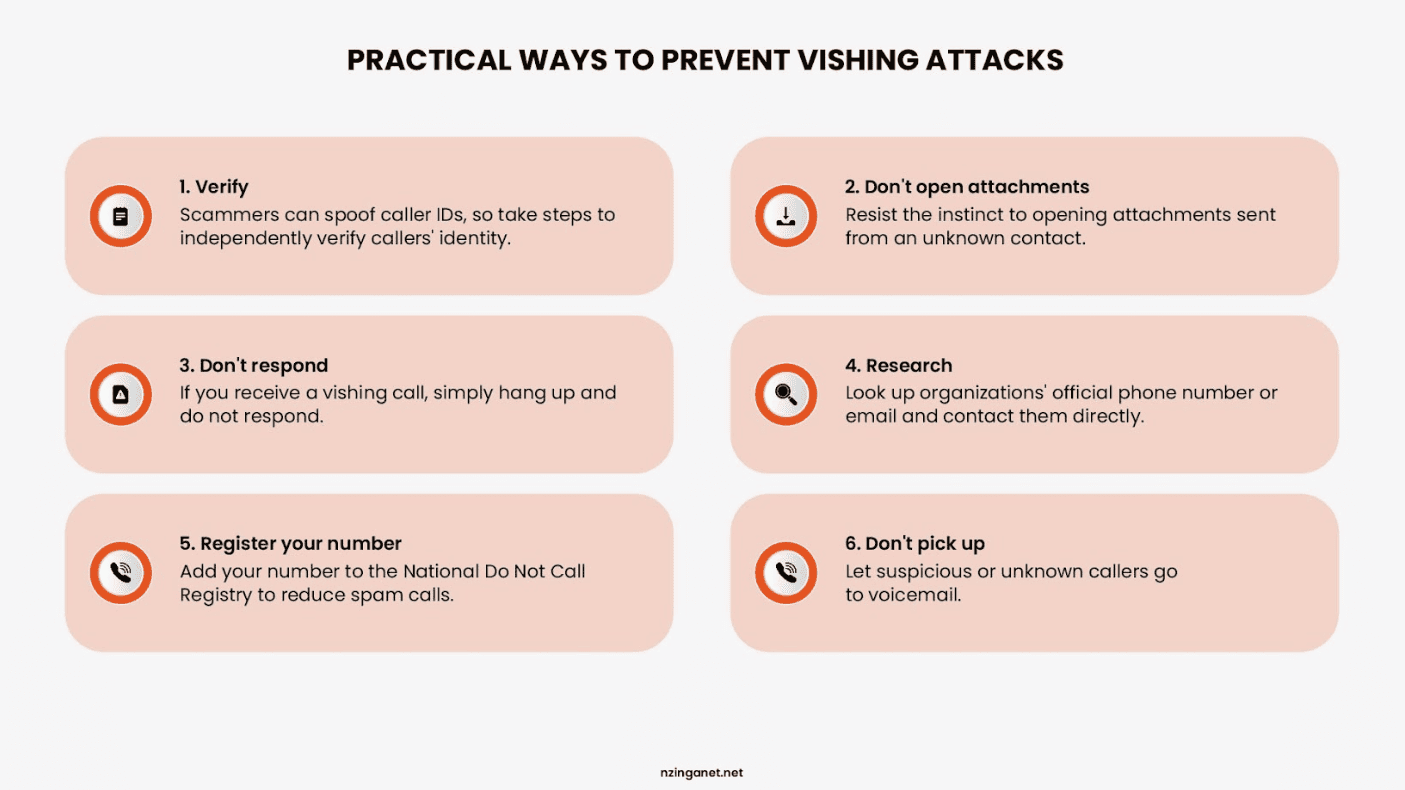
Preventing vishing attacks requires a combination of awareness, verification procedures, and security controls. While attackers continue to refine their social engineering techniques, a few simple precautions can significantly reduce the risk of becoming a victim.
For Individuals
- Do not trust caller ID: Caller ID spoofing allows attackers to make a call appear as though it is coming from a legitimate organization, government agency, or even a trusted contact. Treat caller ID as a convenience feature rather than proof of identity.
- Hang up and verify independently: If someone claims to represent your bank, a government agency, or a service provider, end the call and contact the organization directly using a phone number listed on its official website or documentation. Never rely on a phone number provided by the caller.
- Never share one-time passcodes or verification codes: Legitimate organizations will not ask for authentication codes sent to your device. These codes are intended only for the account owner. Sharing them can give attackers immediate access to your accounts.
- Be cautious of urgency and pressure tactics: Vishing attackers often create a false sense of urgency to push victims into making quick decisions. If a caller pressures you to act immediately, pause and verify the request before taking any action.
- Question unusual payment requests: Requests for payment through gift cards, wire transfers, cryptocurrency, or cash should be treated as a major warning sign. Legitimate organizations do not use these methods to collect taxes, fines, fees, or overdue payments.
For Organizations
- Implement strong identity verification procedures: Employees should never approve sensitive requests based solely on a phone call. Require verification through a separate communication channel, such as a company messaging platform, email confirmation, or face-to-face validation.
- Provide regular vishing awareness training: Security awareness programs should include voice phishing scenarios alongside email phishing exercises. Employees must understand how attackers use phone conversations to gather information and bypass security controls.
- Establish verification protocols: Create documented procedures for requests involving password resets, financial transactions, account changes, or access to sensitive information. High-risk requests should always require secondary verification.
- Monitor for suspicious account activity: Successful vishing attacks often lead to unauthorized logins, privilege escalation, or unusual access patterns. Monitoring authentication logs and user activity can help identify compromised accounts before significant damage occurs.
- Require dual approval for sensitive transactions: Critical actions such as wire transfers, vendor payment changes, and high-value financial transactions should require approval from multiple individuals. This reduces the likelihood that a single employee can be manipulated into authorizing fraud.
Technical Controls
- Deploy AI-powered voice analysis tools: Some security solutions can analyze incoming calls for indicators of synthetic or AI-generated voices. While these technologies are not foolproof, they can provide an additional layer of protection against voice-cloning attacks.
- Use call filtering and spam-blocking services: Carrier-level call filtering and anti-spam services can reduce the number of fraudulent calls reaching employees and consumers. Although these tools cannot stop every attack, they help minimize exposure.
- Protect against SIM-swapping attacks: Many vishing campaigns are linked to SIM-swapping attempts designed to intercept authentication codes and account recovery messages. Adding a PIN, passcode, or carrier lock to your mobile account can make unauthorized SIM changes more difficult.
What to Do If You Are a Vishing Victim
If you believe you have disclosed information to a vishing attacker, act quickly. Immediate action can help limit financial losses and prevent further account compromise.
- End all communication with the attacker: Stop engaging with the caller immediately. Do not answer follow-up calls, return missed calls, or respond to related messages.
- Contact the legitimate organization directly: If the attacker claimed to represent your bank, employer, or another organization, contact that organization through its official support channels. Inform them of the incident and ask them to review your account for suspicious activity.
- Change compromised passwords immediately: If you shared login credentials, update the affected passwords without delay. Create strong, unique passwords for each account and avoid reusing passwords across multiple services.
- Reset or reconfigure multi-factor authentication (MFA): If you provided a one-time passcode or approved an authentication request, assume the attacker may have gained account access. Review and reset your MFA settings where necessary.
- Monitor financial and online accounts: Keep a close watch on bank accounts, credit cards, email accounts, and other critical services for signs of unauthorized activity. Report suspicious transactions or account changes immediately.
- Report the incident: Report the attack to the appropriate authorities and your organization's security team if applicable. Timely reporting can help prevent further compromise and may assist in protecting other potential victims.
Staying Ahead of Vishing Attacks
Vishing is not a new threat, but it is evolving rapidly. Attackers have moved from simple robocalls to sophisticated AI-powered impersonations that can fool even security-conscious individuals. The 442% increase in vishing incidents reflects a strategic shift by cyber criminals who have realized that voice calls bypass most technical defenses.
By now, you should have a clear understanding of what vishing is, how it works, and how to protect yourself against it. Share this knowledge with your team, family, and colleagues. Awareness remains one of the most effective defenses, and vishing attacks are most successful when people are unfamiliar with the warning signs.
If you would like guidance on strengthening your organization's cybersecurity posture, the team at NzingaNet is available to help. Schedule a consultation to discuss your security challenges and explore practical strategies for reducing risk and defending against modern cyber threats.
Need Help Defending Against Vishing Attacks?
NzingaNet helps organizations train employees to recognize vishing and other social engineering tactics before they lead to a costly breach. From awareness training to verification protocols, our team can help you build defenses that hold up against real-world attackers.
COMMON QUESTIONS
Frequently Asked Questions
1. What is vishing in cyber security?
Vishing is a type of cyber attack where criminals use phone calls or voice messages to trick people into revealing sensitive information like passwords, bank account details, or social security numbers. The term combines "voice" and "phishing."
2. How does a vishing attack work?
Attackers impersonate trusted entities like banks, government agencies, or tech support. They create urgency, threaten negative consequences, and pressure victims to share information or take actions like sending money or granting remote access.
3. What is the difference between vishing and phishing?
Phishing uses email. Vishing uses phone calls or voice messages. Both aim to steal information or money, but vishing happens in real time, allowing attackers to adapt their story based on victim responses.
4. How can I identify a vishing call?
Red flags include unsolicited calls requesting personal information, threats of arrest or legal action, demands for immediate payment, requests for one-time codes, and pressure to act without hanging up to verify.
5. How do I prevent vishing attacks?
Hang up and call back using a verified number. Never share verification codes. Do not trust caller ID. Slow down when someone creates urgency. Be skeptical of payment demands through gift cards or cryptocurrency.
6. What is AI voice cloning for vishing?
Attackers use AI tools to clone voices from short audio clips found on social media, podcasts, or voicemails. They then use the cloned voice to impersonate executives or trusted individuals in vishing calls.
PENNSYLVANIA & BEYOND
Ready to Protect Your Team from Vishing and Social Engineering?
NzingaNet helps small and mid-sized businesses across Pennsylvania and the surrounding region defend against vishing and other social engineering attacks through employee training, verification protocols, and layered security controls.