September 23, 2026
PCI Compliance for SMBs: A Practical Guide to Protecting Payment Data
Accepting credit and debit card payments makes it easier for customers to do business with you, but it also creates a responsibility to protect their payment information. PCI compliance helps businesses meet that responsibility through specific security requirements and controls.
For small and mid sized businesses, PCI compliance can feel like a technical or expensive process. In reality, the requirements depend on how your business accepts, processes, and stores cardholder data. You may need to secure payment systems, control access, maintain strong passwords, monitor your environment, and regularly test your security controls.
This guide breaks down PCI compliance for SMBs. You'll learn what PCI DSS requires, which security measures matter most, common compliance mistakes, and practical steps your business can take to protect payment data.
TABLE OF CONTENTS
- What Is MFA Enforcement?
- Why Centralized MFA Enforcement Matters
- Does MFA Really Stop 80% of Cyberattacks?
- Which Cyberattacks Does MFA Help Prevent?
- What MFA Cannot Prevent on Its Own
- Which MFA Methods Provide the Strongest Protection?
- The 5E MFA Enforcement Framework
- How to Roll Out MFA Without Disrupting Employees
- Which Accounts Should Be Protected First?
- Secure MFA Registration and Account Recovery
- How to Verify That MFA Is Actually Being Enforced
- Microsoft 365 MFA Enforcement Options
- When Does an SMB Need Managed MFA Enforcement?
- Strengthen MFA Enforcement With NzingaNet
- Frequently Asked Questions
What Is PCI Compliance?
PCI compliance means following the security requirements designed to protect payment card data. These requirements come from the Payment Card Industry Data Security Standard (PCI DSS), a set of security standards created by the major payment card networks to help businesses protect cardholder information.
If your business accepts, processes, stores, or transmits credit or debit card information, PCI DSS may apply to you. That includes businesses that take payments through websites, point of sale systems, phone orders, mobile devices, or other payment channels. A business that uses a third party payment processor may have fewer responsibilities than one that stores card data on its own systems, but it still needs to understand its PCI obligations.
Does PCI Compliance Apply to Small Businesses?
Yes. PCI DSS can apply to businesses of any size that accept, process, transmit, or store payment card data. Being a small business does not exempt you from PCI requirements.
The PCI Security Standards Council (PCI SSC) states that merchants remain responsible for PCI DSS compliance regardless of their size or transaction volume. Whether you run a retail store, online business, or service company that accepts card payments, your payment environment determines which security requirements apply.
How you process payments can also affect your PCI scope. For example, using a third party payment provider and avoiding the storage of cardholder data may reduce the systems and processes covered by your compliance responsibilities. It does not, however, remove those responsibilities entirely. You still need to understand which security controls your business must maintain and which your payment provider handles.
Compliance vs. Validation
PCI compliance and PCI validation are related, but they are not the same thing. Compliance means your business follows the PCI DSS requirements that apply to its payment environment. Validation is the process used to demonstrate that you meet those requirements.
For example, an SMB may secure its payment systems, restrict access to cardholder data, maintain secure configurations, monitor its environment, and address vulnerabilities. Those activities contribute to PCI DSS compliance. The business may then use a Self Assessment Questionnaire (SAQ), Attestation of Compliance (AOC), or another required assessment method to document and validate its compliance.
The validation method depends on factors such as your payment setup, transaction volume, card brands involved, and the requirements of your acquiring bank or payment processor. Some businesses may be eligible to complete an SAQ, while others may need an assessment performed by a qualified security assessor.
Completing a validation document does not automatically make a business compliant. Your security practices must actually meet the applicable PCI DSS requirements. Keeping those controls in place throughout the year is what supports ongoing compliance.
What Changed With PCI DSS v4.0.1?
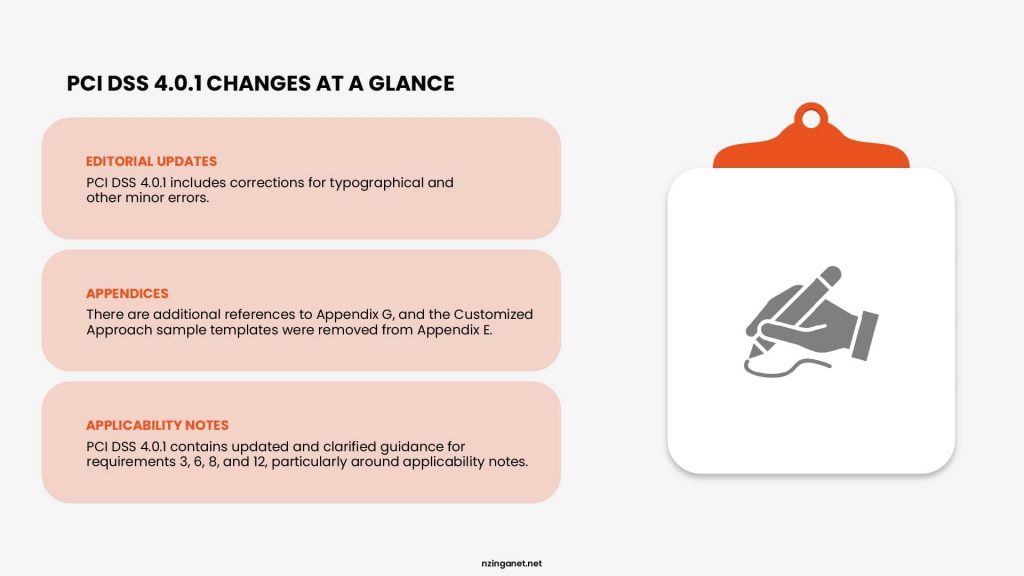
PCI DSS v4.0.1 did not introduce an entirely new set of compliance requirements. Instead, the PCI Security Standards Council (PCI SSC) released it in June 2024 as a limited revision to correct errors, clarify requirements, and provide additional guidance based on industry feedback. The Council confirmed that v4.0.1 added or removed no requirements compared with v4.0.
The more significant changes came with PCI DSS v4.0, which introduced a stronger focus on risk based security, flexibility in how organizations meet security objectives, and controls designed to address evolving payment threats. These changes included expanded multi factor authentication requirements, updated vulnerability management practices, targeted risk analysis, and greater attention to payment page security.
PCI DSS v4.0.1 also clarified several areas that matter to SMBs, including:
- Critical vulnerability patching: The standard clarified that the 30 day patching requirement applies specifically to critical vulnerabilities.
- Multi factor authentication: Additional guidance clarified how MFA requirements apply to certain authentication methods and access scenarios.
- Payment page security: Applicability notes clarified requirements related to managing scripts on payment pages.
- Third party service providers: The standard provided additional clarification around responsibilities between businesses and their third party service providers.
One of the most important dates for businesses was March 31, 2025, when the future dated requirements introduced with PCI DSS v4.0 became effective. These requirements included additional controls across areas such as vulnerability management, authentication, payment page security, and ongoing security monitoring.
In June 2026, PCI SSC clarified that ecommerce merchants using SAQ A still have external vulnerability scanning requirements for merchant webpages, even when payment processing is fully outsourced and customers are redirected to a third-party payment provider or use an embedded third-party iframe.
The 12 PCI DSS Requirements Explained for SMBs
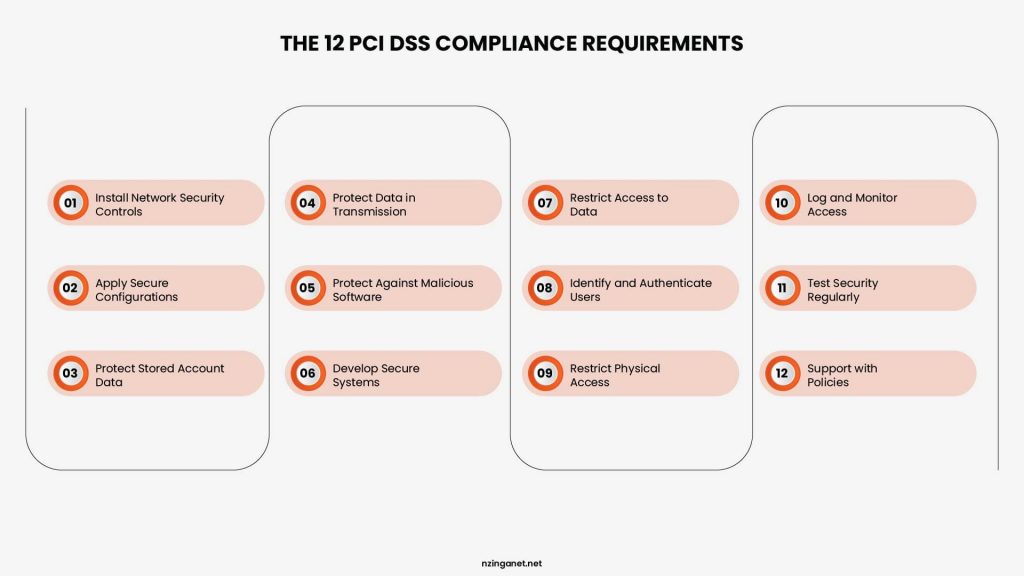
The 12 PCI DSS requirements provide the foundation for protecting payment card data. They cover everything from securing networks and systems to controlling access, detecting vulnerabilities, monitoring activity, and maintaining security policies.
The exact requirements that apply to your business depend on your payment environment and PCI DSS scope. For example, a business that uses a fully outsourced payment solution may have a different set of responsibilities from one that stores or processes cardholder data on its own systems.
Here is what each requirement means in practical terms for an SMB:
1. Install and Maintain Network Security Controls
Your business needs controls that protect the systems and networks involved in payment processing. This includes controlling network traffic, restricting unnecessary connections, and separating payment systems from other parts of the business where appropriate. For an SMB, this could mean properly configuring firewalls, routers, wireless networks, and other security technologies that protect the cardholder data environment.
2. Apply Secure Configurations to Systems
Default passwords, unnecessary accounts, and insecure system settings can create easy entry points for attackers. PCI DSS requires businesses to establish and maintain secure configurations for systems within scope. SMBs should change vendor supplied default credentials, disable unnecessary services and accounts, and maintain documented configuration standards for relevant systems.
3. Protect Stored Account Data
If your business stores payment card data, PCI DSS requires you to protect it against unauthorized access. This includes applying appropriate controls to stored account data and limiting what information the business retains. The simplest approach for many SMBs is to avoid storing cardholder data unless there is a genuine business need to do so. Reducing the amount of payment data you retain can also reduce your PCI scope and potential exposure.
4. Protect Cardholder Data During Transmission
Cardholder data needs protection when it travels across networks that could expose it to unauthorized access. Businesses must use appropriate security measures, such as strong cryptography, when transmitting account data over open, public networks. For SMBs, this can involve ensuring payment systems, websites, remote connections, and other relevant services use properly configured encryption.
5. Protect Systems Against Malicious Software
Malware can compromise payment systems and expose sensitive information. PCI DSS requires organizations to protect systems within scope against malicious software and maintain appropriate anti malware controls where required. SMBs should keep security software and operating systems current, monitor for potential threats, and ensure employees understand how malware can enter the environment.
6. Develop and Maintain Secure Systems and Software
Security needs to continue after a system or application goes live. Businesses must identify and address vulnerabilities, apply security updates, and follow secure development practices where applicable. One important change under PCI DSS v4.x is the stronger focus on keeping software and systems secure throughout their lifecycle. SMBs should establish a process for identifying vulnerabilities, prioritizing critical issues, and applying security updates within the required timeframes.
7. Restrict Access to Payment Data
Employees should only have access to the systems and data they need to perform their jobs. PCI DSS follows the principle of least privilege, meaning users receive only the level of access necessary for their responsibilities. For a small business, this might mean separating administrator accounts from everyday user accounts, reviewing permissions regularly, and removing access when an employee changes roles or leaves the company.
8. Identify Users and Authenticate Access
Every person who accesses systems within the PCI scope should have a unique identity. Shared accounts can make it difficult to determine who performed an action and can increase the risk of unauthorized access. PCI DSS also places greater emphasis on strong authentication, including multi factor authentication in applicable scenarios. SMBs should use unique user IDs, strong authentication methods, and appropriate access controls for systems handling payment data.
9. Restrict Physical Access to Cardholder Data
Payment data can be exposed through physical access just as easily as through a cyberattack. Businesses need controls that prevent unauthorized people from accessing payment devices, systems, and physical records containing account data. For SMBs, this may include securing payment terminals, restricting access to areas containing payment systems, and properly destroying physical records that contain sensitive payment information.
10. Monitor and Test Systems Regularly
Security controls need ongoing monitoring to identify suspicious activity and potential weaknesses. PCI DSS requires organizations to log and monitor relevant activity and regularly test security controls. This can include reviewing logs, monitoring access to critical systems, detecting unauthorized changes, and performing required security testing. The goal is to identify problems before they become larger security incidents.
11. Regularly Test Security Systems and Processes
A security control may look effective on paper but fail when an attacker tries to exploit a weakness. PCI DSS therefore requires organizations to test certain security controls regularly. Depending on your environment, this may involve vulnerability scans, penetration testing, wireless testing, network security testing, or other technical assessments. Your specific testing obligations depend on which PCI DSS requirements apply to your environment.
12. Maintain an Information Security Policy
PCI compliance is not only a technical responsibility. Your business also needs policies and procedures that explain how employees, systems, vendors, and management should handle security. For an SMB, this does not necessarily mean creating hundreds of pages of documentation. PCI DSS recognizes that security policies should be appropriate for the size and complexity of the business. Policies should clearly define security responsibilities, acceptable technology use, incident response procedures, and other relevant practices.
Which PCI Self-Assessment Questionnaire Do You Need?
A PCI Self-Assessment Questionnaire (SAQ) is a validation tool that eligible merchants can use to assess whether their payment environment meets applicable PCI DSS requirements. However, there is no single SAQ that applies to every SMB.
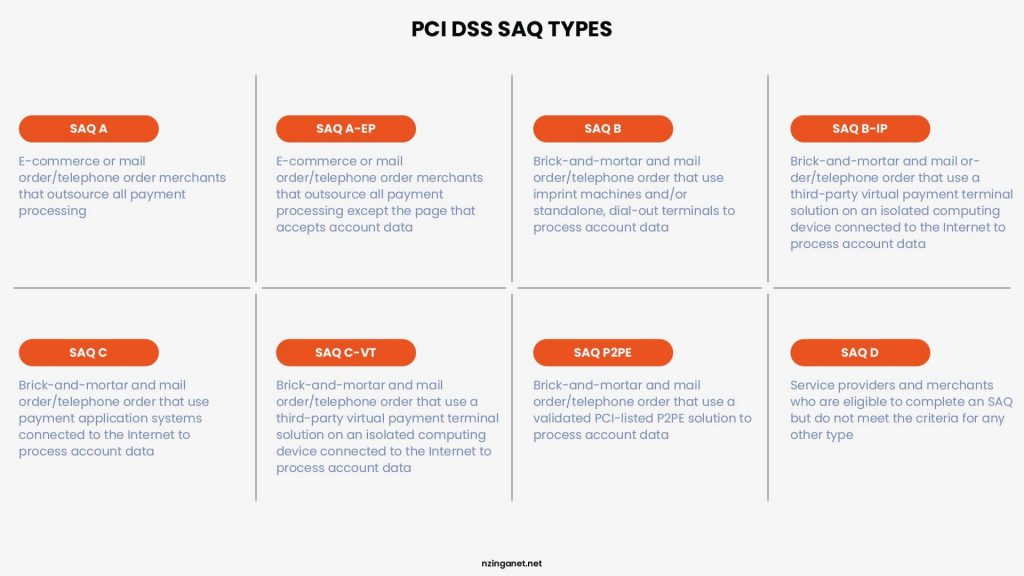
The right questionnaire depends on how your business accepts payments, whether cardholder data enters your systems, and how much of the payment process you outsource. Choosing the wrong SAQ can leave important security requirements unaddressed, so businesses should first understand their payment flow and confirm the appropriate validation method with their acquiring bank or payment processor.
Here are some common SAQ scenarios SMBs may encounter:
| Payment Environment | Potential SAQ | Typical Scenario |
|---|---|---|
| Fully outsourced e commerce payments | SAQ A | Customers enter card details directly into a payment page hosted by a PCI compliant third party, with no electronic storage, processing, or transmission of cardholder data by the merchant. |
| E commerce with merchant website involvement | SAQ A-EP | A third party handles payment processing, but the merchant's website can affect the security of the payment transaction. |
| Standalone payment terminals | SAQ B / B-IP | Card payments are accepted through eligible standalone or IP connected terminals that do not electronically store cardholder data. |
| Card not present payments | SAQ C-VT | Employees manually enter payment information into a virtual terminal provided by a payment processor. |
| Internet connected payment systems | SAQ C | Payment applications or systems connect to the internet and process cardholder data without storing it electronically. |
| Payment applications with electronic card data storage | SAQ D | The merchant stores, processes, or transmits cardholder data electronically and does not qualify for a more specific SAQ. |
The safest approach is to start with your payment flow rather than choosing an SAQ based on your business size. Identify where card data enters your environment, which systems handle it, what you store, and which payment functions a third party manages. Then use the applicable PCI SSC guidance and confirm the required validation method with your acquiring bank or payment processor.
A Simple Way to Determine Your SAQ
Ask these questions:
- Do customers enter their card details directly into a payment page hosted by a third party?
- Does cardholder data ever enter your business systems?
- Do employees manually enter card details into a virtual terminal?
- Do you use physical payment terminals or internet connected point of sale systems?
- Does your business store payment card data electronically?
- Does your website influence the security of the payment transaction?
Your answers can help narrow down which SAQ may apply, but they do not replace the official eligibility criteria. When your payment environment is complex or unclear, confirm your requirements with your acquiring bank, payment processor, or a qualified PCI professional.
Remember: completing an SAQ is not the same as achieving compliance. The questionnaire documents how your environment meets the applicable PCI DSS requirements; your business remains responsible for maintaining those controls.
PCI Compliance for Ecommerce SMBs
Selling online does not automatically mean an ecommerce business has to handle or store cardholder data itself. The way your website processes payments can significantly affect your PCI DSS scope and compliance responsibilities.
For many SMBs, using a third party payment provider can reduce the systems that fall within PCI scope. However, outsourcing payment processing does not automatically eliminate PCI responsibilities. Your business still needs to understand how the payment process works, what systems are involved, and which security controls remain under your control.
Common e-commerce payments setups include:
Hosted payment page
Customers are redirected from your website to a payment page hosted by a third party payment provider. The provider handles the payment data, while your website does not electronically store, process, or transmit cardholder data. This setup can reduce PCI scope, but your website and payment integration still need to meet the applicable requirements.
Embedded payment form or payment fields
Customers remain on your website while entering their payment details through payment fields provided by a third party. Although the payment provider processes the card data, the security of your website can still affect the payment transaction. This makes website security particularly important. Compromised scripts, plugins, or other website components could potentially interfere with the payment process.
Merchant controlled payment processing
Some ecommerce businesses process or transmit payment card data through their own website, servers, applications, or other systems. This creates a broader PCI environment because more of the merchant's technology infrastructure may fall within scope.
Key PCI Practices for Ecommerce SMBs
Regardless of your payment setup, ecommerce businesses should pay close attention to:
- Website security: Keep your ecommerce platform, plugins, themes, and other components updated and securely configured.
- Payment page security: Monitor payment pages and scripts for unauthorized changes or suspicious activity.
- Access controls: Limit administrative access to employees and vendors who need it and use strong authentication.
- Third party providers: Understand which PCI responsibilities belong to your payment processor, hosting provider, ecommerce platform, and your business.
- Vulnerability management: Regularly identify and address security vulnerabilities affecting systems involved in payment processing.
- Data retention: Avoid storing cardholder data unless your business has a legitimate need and appropriate controls to protect it.
- Monitoring: Maintain appropriate logging and monitoring for systems that fall within your PCI scope.
The most effective approach for many SMBs is to minimize the amount of cardholder data their own environment handles. A properly implemented third party payment solution can reduce PCI scope, but it does not make website security or merchant responsibilities disappear.
Before selecting an ecommerce payment setup, map the entire payment journey from the moment a customer enters payment information to the point the transaction is completed. This helps your business understand where cardholder data flows, which systems are in scope, and what PCI DSS controls you need to maintain.
What Are the PCI Merchant Levels?
PCI DSS applies to businesses that store, process, or transmit payment card data regardless of their size or transaction volume. However, merchant levels and validation requirements are determined by individual payment brands, so there is no single four level classification that applies universally to every business.
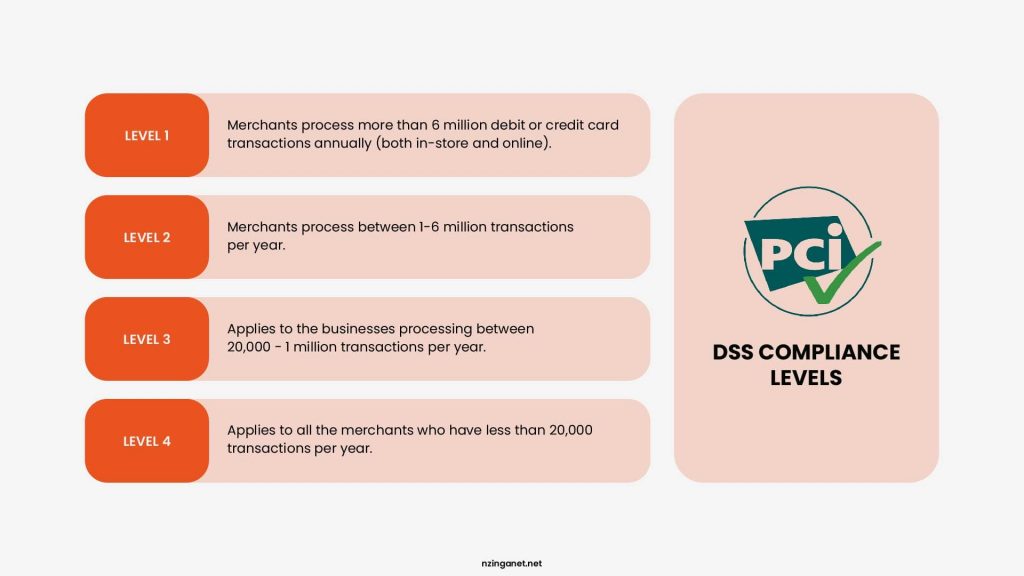
For example, Mastercard classifies merchants into four levels based on transaction volume and other criteria. Visa uses its own criteria. Your acquiring bank or payment brand determines which level applies to your business and what documentation or assessment you need to provide.
PCI Merchant Levels: Mastercard Example
| Level | Mastercard Transaction Criteria | Typical Validation |
|---|---|---|
| Level 1 | More than 6 million combined Mastercard and Maestro transactions annually, or other criteria specified by Mastercard | Annual PCI DSS assessment resulting in a Report on Compliance (ROC) |
| Level 2 | More than 1 million up to 6 million combined Mastercard and Maestro transactions annually | Annual Self Assessment Questionnaire (SAQ), with additional requirements for certain SAQs |
| Level 3 | More than 20,000 up to 1 million combined Mastercard and Maestro ecommerce transactions annually | Annual Self Assessment Questionnaire (SAQ) |
| Level 4 | All other merchants that do not meet Levels 1, 2, or 3 criteria | PCI DSS compliance required; annual SAQ may be used for validation |
Note: Merchant levels and validation requirements vary by payment brand. Confirm the requirements that apply to your business with your acquiring bank or payment brand.
Practical PCI Best Practices for Small Businesses
PCI compliance becomes easier to manage when you treat payment security as an ongoing business practice rather than a once a year checklist. Small businesses can reduce their exposure by limiting access, minimizing stored payment data, securing systems, and regularly reviewing their security controls.
Here are practical PCI best practices SMBs can put into place:
1. Avoid Storing Cardholder Data
The less payment data your business stores, the less data you have to protect. Use a trusted payment processor or tokenization solution where appropriate, and avoid keeping card numbers in spreadsheets, email accounts, databases, or paper records.
2. Use Strong Authentication
Require unique user accounts and strong passwords for systems that handle payment information. Enable multi factor authentication wherever PCI DSS requires it and for other critical systems where it provides additional protection.
3. Limit Employee Access
Not every employee needs access to payment systems or sensitive information. Follow the principle of least privilege by giving users only the permissions required for their roles. Review access regularly and remove accounts promptly when employees leave the business.
4. Keep Systems and Software Updated
Outdated operating systems, ecommerce platforms, plugins, payment applications, and other software can contain vulnerabilities that attackers may exploit. Establish a routine for applying security updates and addressing vulnerabilities within the required timeframes.
5. Secure Payment Devices
Keep point of sale terminals and other payment devices in secure locations. Employees should know how to identify signs of tampering or unauthorized replacement, and businesses should inspect devices according to their established procedures.
How to Reduce PCI Compliance Scope
The larger your payment environment, the more systems, processes, and people may fall within your PCI DSS scope. For SMBs, reducing that scope can make compliance easier to manage while also limiting the number of places where payment data could be exposed.
The key is to minimize how your business handles cardholder data. You cannot simply exclude a system from scope because it is difficult to secure. A system is generally in scope when it can impact the security of the cardholder data environment.
Here are practical ways SMBs can reduce their PCI scope:
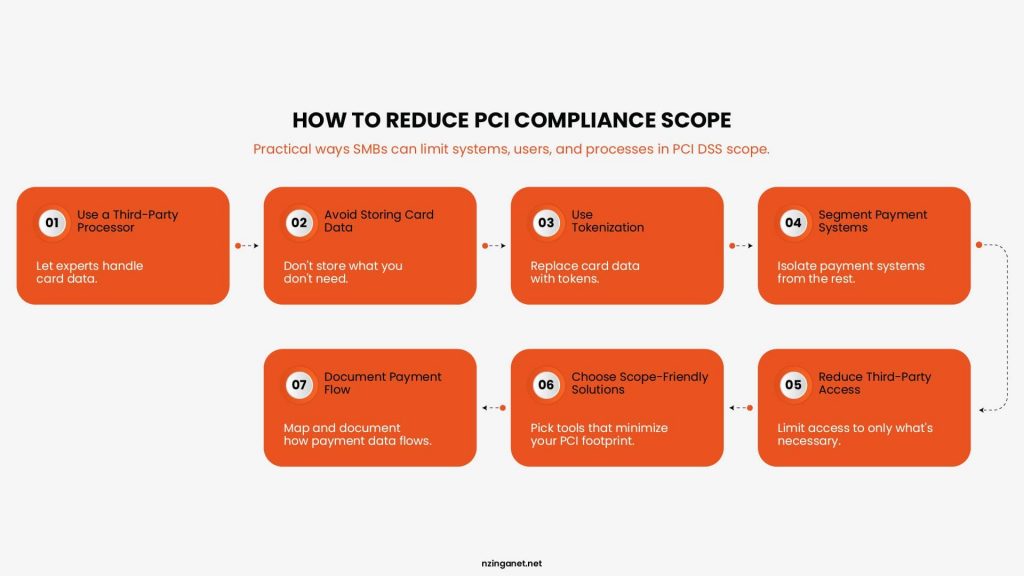
Use a Third Party Payment Processor
Instead of processing card payments directly through your own systems, consider using a reputable third party payment provider that handles the payment data on your behalf.
For ecommerce businesses, a hosted payment page can keep cardholder data away from the merchant's website. In a physical location, an appropriately configured payment terminal can similarly reduce the systems involved in payment processing.
Outsourcing payment processing does not remove your PCI responsibilities, but it can reduce the number of systems your business needs to secure.
Avoid Storing Cardholder Data
One of the simplest ways to reduce PCI scope is to avoid storing payment card data unless there is a legitimate business need.
Do not keep card numbers in spreadsheets, databases, email accounts, customer records, or other systems unnecessarily. If your business does not need to retain the data, eliminating it can remove systems and processes from the scope of certain requirements.
Use Tokenization
Tokenization replaces sensitive payment information with a token that has no usable value outside the specific payment environment. For example, your business may store a payment token for future transactions instead of retaining the customer's actual card number. The payment provider maintains the underlying card information, while your systems work with the token.
Separate Payment Systems From Other Networks
Network segmentation can help isolate systems that handle payment data from the rest of your business environment. For example, keeping payment systems separate from employee workstations, guest Wi Fi, and unrelated business applications can limit the systems that can affect the security of the cardholder data environment.
Segmentation needs to be properly designed and maintained. Simply placing systems on different network segments does not automatically remove them from PCI scope.
Reduce Third Party Access
Vendors and service providers may need access to systems that support payment processing, but unnecessary access can increase your security exposure. Review vendor accounts regularly, restrict permissions to what each provider actually needs, and remove access when it is no longer required.
Choose Payment Solutions With Scope in Mind
PCI scope should be considered when selecting ecommerce platforms, payment processors, point of sale systems, and other payment technologies. Before implementing a new solution, ask:
- Does the solution store cardholder data?
- Does cardholder data pass through our systems?
- Does our website affect the payment transaction?
- Which systems will be considered in scope?
- Which PCI responsibilities remain with our business?
- What responsibilities does the provider handle?
These questions can help you compare payment solutions based on more than price and features.
Document Your Payment Flow
You cannot reduce PCI scope effectively if you do not know where payment data goes. Map the payment process from the moment a customer provides payment information through authorization, settlement, storage, and any subsequent transactions. Identify every system, application, device, vendor, and connection involved.
Once you understand this flow, you can identify unnecessary points where your business handles payment data and determine whether those processes can be outsourced, eliminated, or isolated.
When Should an SMB Get Professional PCI Help?
If your payment environment is simple, your systems are well managed, and you clearly understand your applicable PCI DSS requirements, you may be able to manage many compliance activities internally.
Professional help becomes valuable when your payment environment is complex, your responsibilities are unclear, or you do not have the technical expertise to verify that your controls work as required.
Consider getting professional PCI guidance if your business:
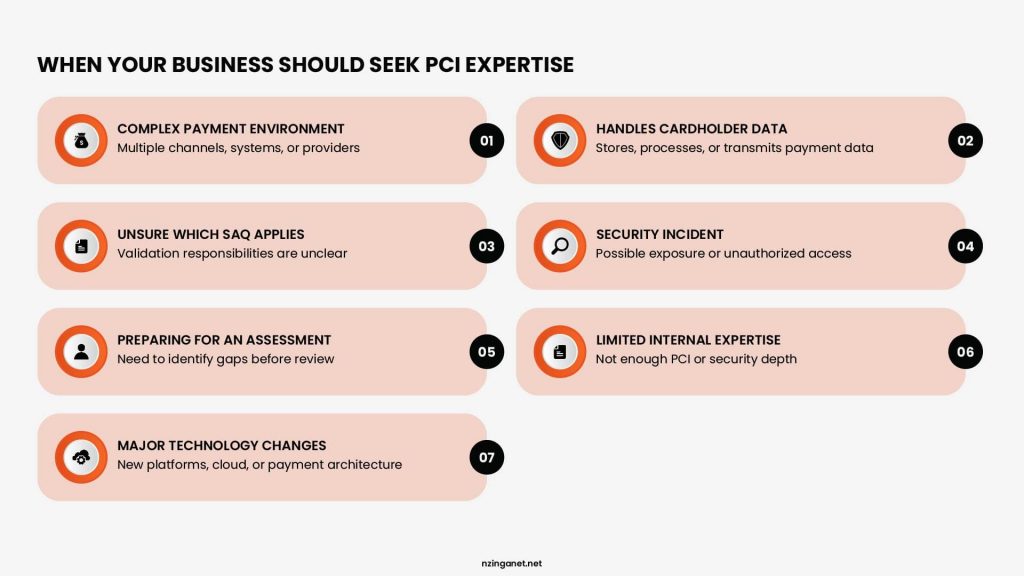
Has a Complex Payment Environment
Multiple payment channels, ecommerce platforms, point of sale systems, payment applications, and third party providers can make it difficult to determine what falls within PCI scope. A qualified professional can help map your payment environment, identify connected systems, and clarify your compliance responsibilities.
Stores or Processes Cardholder Data
Handling cardholder data internally increases both your security responsibilities and potential exposure. If your business stores, processes, or transmits payment data through its own systems, professional guidance can help you identify appropriate controls and reduce unnecessary data handling.
Is Unsure Which SAQ to Complete
Choosing the wrong Self Assessment Questionnaire can leave important requirements unaddressed. If you are uncertain which SAQ applies to your payment environment, a PCI professional can help you understand the applicable validation requirements. However, your acquiring bank or payment processor may ultimately determine which validation method they require.
Has Experienced a Security Incident
If you suspect that payment data has been exposed, compromised, or accessed without authorization, do not treat it as a routine compliance issue. You may need specialized assistance with containment, investigation, forensic analysis, notification requirements, and remediation. Contact your payment processor or acquiring bank promptly and follow your incident response procedures.
Is Preparing for an Assessment
Some businesses may need to complete more extensive validation activities depending on their payment environment, transaction volume, or contractual obligations. If you are preparing for an assessment, an experienced PCI professional can identify gaps before the formal review begins.
Lacks Internal Security Expertise
PCI DSS covers areas such as network security, vulnerability management, access control, authentication, logging, testing, and incident response. If your business does not have someone with the technical knowledge to manage these areas, outside expertise can help fill the gap.
Is Making Major Technology Changes
Changing payment processors, launching a new ecommerce platform, moving systems to the cloud infrastructure, adding new payment channels, or changing how your business stores customer information can change your PCI scope.
Bringing in professional guidance before making a significant change can help you choose a payment architecture that limits unnecessary compliance obligations.
Strengthen PCI Readiness With NzingaNet
PCI compliance does not have to become a complicated project for your business. The right approach starts with understanding your payment environment, identifying what falls within PCI scope, and putting practical security controls in place.
NzingaNet helps SMBs strengthen their security posture and prepare for PCI DSS requirements through services designed around their technology environment and business needs. Our team can help identify security gaps, improve access controls, strengthen network security, address vulnerabilities, and build processes that support ongoing compliance.
Need Help With PCI Compliance?
NzingaNet helps SMBs strengthen their security posture and prepare for PCI DSS requirements through services designed around their technology environment and business needs.
Frequently Asked Questions
PENNSYLVANIA & BEYOND
Ready to Strengthen Your PCI Readiness?
NzingaNet helps SMBs strengthen their security posture and prepare for PCI DSS requirements through services designed around their technology environment and business needs.