April 14, 2026
Managed IT services pricing is one of those topics where the more you search, the less useful the results become. The costs themselves are consistent across the industry, but what you pay depends heavily on variables specific to your business, and without understanding those variables, a pricing figure on its own does not give you much to work with.
That gap between a number and what it actually means for your organization is worth closing before you speak with any provider, request any quote, or make any decision about your IT investment.
This article breaks down every pricing model in use today, gives you real cost ranges by business size and industry, walks through what a standard agreement actually includes, and gives you a practical way to calculate whether MSP pricing delivers genuine value compared to what your organization is spending right now.
TL;DR
Managed IT services pricing in 2026 typically falls between $110 and $400 per user per month, with most small to mid-sized businesses paying between $125 and $300 per user per month depending on service tier. Total monthly fees for SMBs generally range from $1,000 to $15,000. Basic plans start around $75 to $150 per user; standard plans with security included run $125 to $250; and premium or advanced plans reach $250 to $400 or above. What that fee covers, however, varies significantly from one provider to the next.
|
$110-$400
Per user/month (2026 range)
|
$1K-$15K
SMB total monthly fee
|
20-40%
Avg. savings vs. in-house IT
|
$25K/hr
Max unplanned downtime cost
|
TABLE OF CONTENTS
- Key Pricing Trends in 2026
- Why Pricing Varies So Much
- Main MSP Pricing Models Explained
- Pricing by Business Size
- What Is and Is Not Typically Included
- The Real ROI of MSP Pricing
- What Factors Drive Pricing Up or Down
- How to Compare Quotes Without Getting Misled
- Pricing by Industry in 2026
- Evaluating Managed IT Services Pricing
- Frequently Asked Questions
2026 MARKET TRENDS
Key Managed IT Services Pricing Trends in 2026
The managed IT market has shifted meaningfully over the past two years. Understanding these trends helps you interpret why MSP pricing quotes look the way they do and what you should expect from any modern provider.
Per-User Pricing Dominance
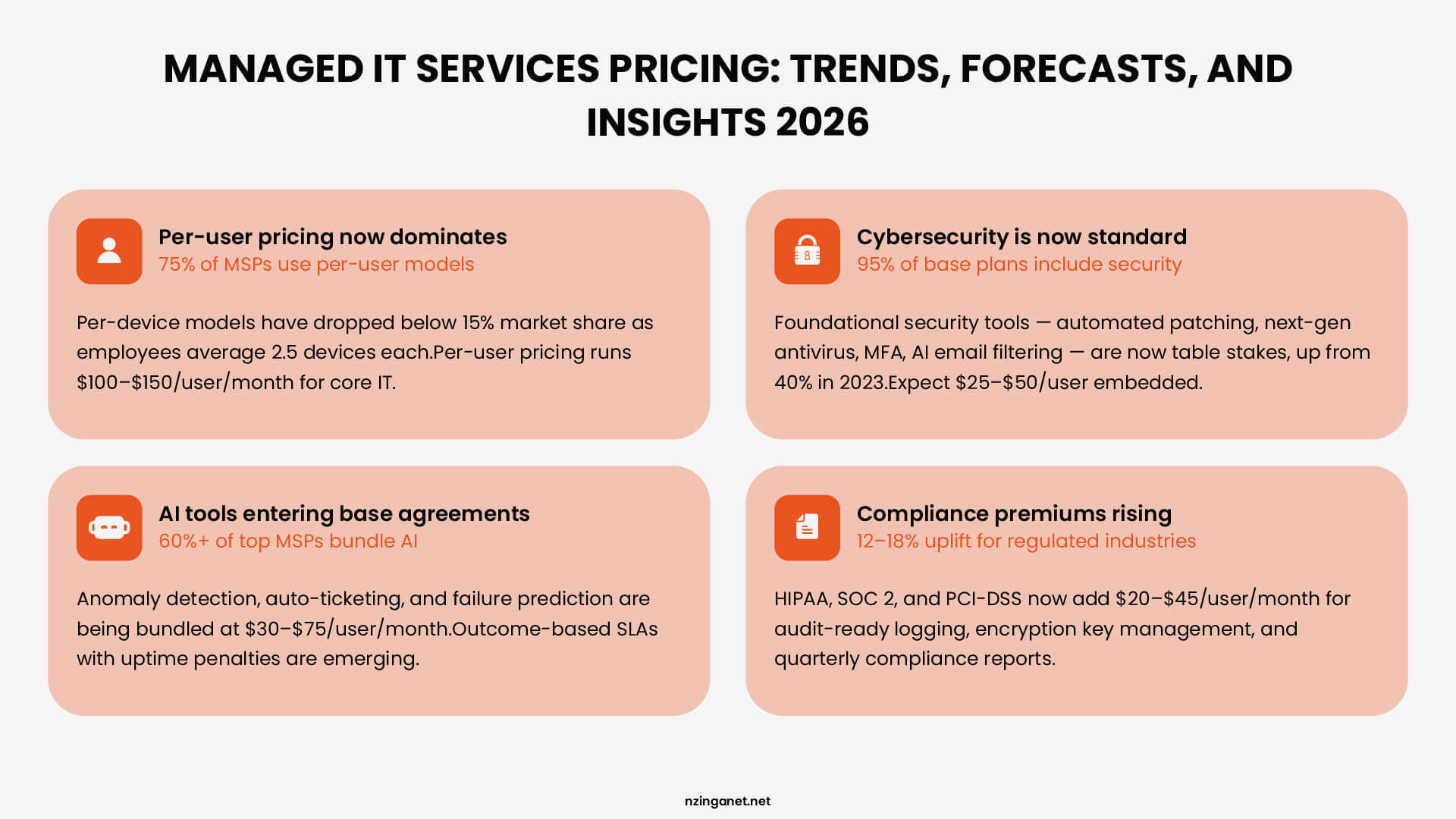
Per-device models have dropped below 15% market share as employees average 2.5 devices each in distributed setups. Per-user pricing, now used by 75% of MSPs, locks costs at $100-$150/user/month for core IT, scaling linearly with staff growth and avoiding overcharges for personal laptops.
Cybersecurity as Standard
Basic endpoint protection was once an add-on. In 2026, foundational security tools such as automated patching, next-gen antivirus, MFA enforcement, and AI-driven email filtering are now table stakes in 95% of base plans, up from 40% in 2023. Expect $25-$50/user/month embedded; add-ons like 24/7 SOC or dark web alerts cost extra at $40-$100/user.
AI and Outcome-Based Emergence
Over 60% of top MSPs bundle AI tools for anomaly detection (95% accuracy), auto-ticketing (cutting MTTR by 40%), and failure prediction, adding $30-$75/user/month. Pioneers like ConnectWise offer 99.9% uptime SLAs with penalties, blending subscriptions (80%) and outcomes (20%) for predictable ROI.
Compliance Premiums
HIPAA, SOC 2 Type II, and PCI-DSS now trigger 12-18% uplifts ($20-$45/user/month) for audit-ready logging, encryption key management, and quarterly reports. Non-compliant MSPs risk fines up to $50K/incident, making this a must for healthcare/finance.
Vertical Specialization
MSPs targeting healthcare (30% premium) or finance (25%) embed industry-specific playbooks like FHIR integrations or SWIFT monitoring, reducing breach response from 48 to 12 hours. Generalists charge flat rates; vertical experts justify 15-30% more via tailored ROI metrics.
COST VARIATION
Why Does Managed IT Services Pricing Vary So Much?
Managed IT services pricing varies because providers offer different service scopes, ranging from basic "monitoring-only" to comprehensive "all-inclusive" support. Key variables include the number of users, security requirements, and geographic location, with monthly costs typically ranging from $100 to $300 per user.
Pricing differences often come down to the scope of services included. Two providers may both call their offering "managed IT services," but one might provide only help desk support and basic monitoring, while another includes full cybersecurity, compliance management, strategic planning, and 24/7 response. These are very different offerings, even under the same label.
Other variables that affect cost include the number of users and devices, the complexity of your infrastructure, desired response times, your provider's location, and your industry. Understanding these factors helps you evaluate MSP pricing quotes accurately, rather than simply comparing monthly totals for services that may cover very different needs.
PRICING STRUCTURES
The Main MSP Pricing Models Explained
Managed service providers use five primary pricing structures in 2026. Each one has legitimate advantages depending on your business type, size, and priorities. Knowing how each model works before you start speaking with providers puts you in a much stronger position to ask the right questions and understand what you are actually agreeing to.
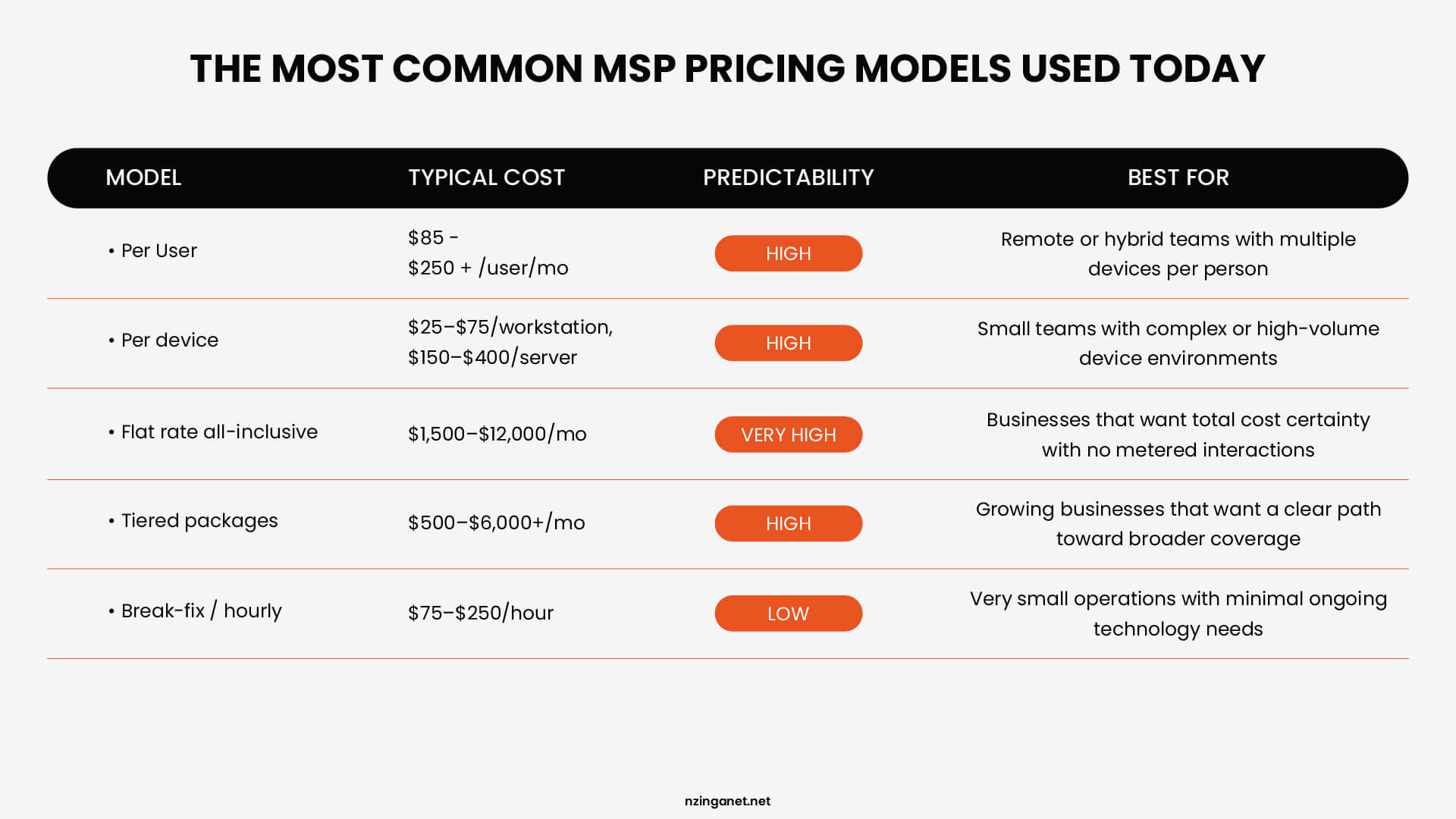
| Model | Typical Cost Range | Best For | Predictability |
|---|---|---|---|
| Per User | $85-$250+/user/month | Remote/hybrid workforce | High |
| Per Device | $25-$75/workstation · $150-$400/server | Complex device environments | Medium |
| Flat Rate | $1,500-$12,000/month | Businesses wanting cost certainty | Very High |
| Tiered | $500-$6,000+/month | Growing businesses | High |
| Break-Fix | $75-$150/hr remote · $100-$250/hr on-site | Very small operations | Low |
1. Per User Pricing
Per user pricing charges a flat monthly fee for each employee in your organization, regardless of how many devices that person uses. If an employee works from a laptop, a desktop, and a tablet, the fee remains the same as it would be for someone using a single workstation. This model is popular because it is straightforward to predict and scales naturally alongside your headcount.
When you hire someone new, you know exactly what the IT cost of that hire looks like. Under this structure, MSP pricing for standard managed IT coverage typically falls between $85 and $175 per user per month, with higher tiers reaching $250 or above when advanced security services are included.
Per user pricing tends to work best for organizations with remote or hybrid workforces where individual employees use multiple devices and tracking costs per device would become unnecessarily complicated.
2. Per Device Pricing
Per device pricing applies a separate monthly fee to each piece of managed hardware, including workstations, laptops, servers, firewalls, and network equipment. Some providers prefer this model because it directly reflects the actual labor and tooling involved in managing infrastructure.
From a business perspective, it can work well when your organization has a relatively small number of employees but a complex or high-volume device environment. Typical per device rates sit around $25 to $75 per workstation per month and $150 to $400 per server per month, depending on the provider and what management services are applied to each device.
3. Flat Rate All-Inclusive Pricing
Flat rate pricing covers everything defined within the service agreement for a single predictable monthly fee, regardless of how many support tickets are submitted or how many hours your provider spends on your account in a given month.
This structure appeals strongly to businesses that want total cost certainty and do not want to meter every interaction they have with their IT partner. It also creates a useful alignment of incentives between you and your provider. When the fee is fixed regardless of volume, the provider has a genuine financial reason to keep your systems running well and prevent problems rather than simply responding to them after the fact.
When evaluating managed IT services pricing under this model, flat rate agreements typically range from $1,500 to $12,000 per month depending on organization size and the breadth of services the agreement covers.
4. Tiered Pricing and Service Level Packages
A significant number of managed service providers offer two or three clearly defined packages at different price points, allowing businesses to choose a level of service that matches their current needs and budget.
These packages are commonly structured around basic monitoring and support at the entry level, more comprehensive coverage with enhanced security tools in the middle tier, and fully managed services with strategic advisory support at the top level.
What separates the tiers typically includes response time guarantees, the depth of cybersecurity protection included, whether after-hours coverage is provided, and access to services like virtual CIO support for technology planning and budgeting.
Under tiered managed IT services plans, entry level packages commonly run between $500 and $2,000 per month, mid-tier packages between $2,000 and $6,000 per month, and advanced packages from $6,000 upward. This structure works particularly well for growing businesses that want a clear path toward broader coverage without committing to a large agreement before they are ready.
5. Break-Fix and Hourly Support
Break-fix is technically a separate category from managed IT, but it appears in this comparison because many businesses default to it before exploring a managed approach. Under this model, you call for support when something goes wrong and pay an hourly rate for the time spent fixing it.
The appeal is that there is no ongoing monthly commitment. The limitation is that there is also no proactive monitoring, no regular maintenance, no strategic guidance, and no incentive for your provider to prevent the problems that generate their revenue. On-site break-fix support typically costs between $100 and $250 per hour, with remote support ranging from $75 to $150 per hour depending on the provider and your location.
For very small operations with minimal technology needs, this model can make sense. For a growing business, the cumulative cost of IT support under a reactive arrangement, combined with the compounding cost of deferred maintenance, tends to exceed the predictable fee of a managed services agreement within a relatively short period.
SIZE-BASED PRICING
Managed IT Services Pricing by Business Size
One of the clearest ways to interpret MSP pricing in this space is by looking at what organizations of similar size typically pay. While scope variation means these ranges are not universal, they give you a reasonable reference point for evaluating whether a quote you receive is in the right territory.
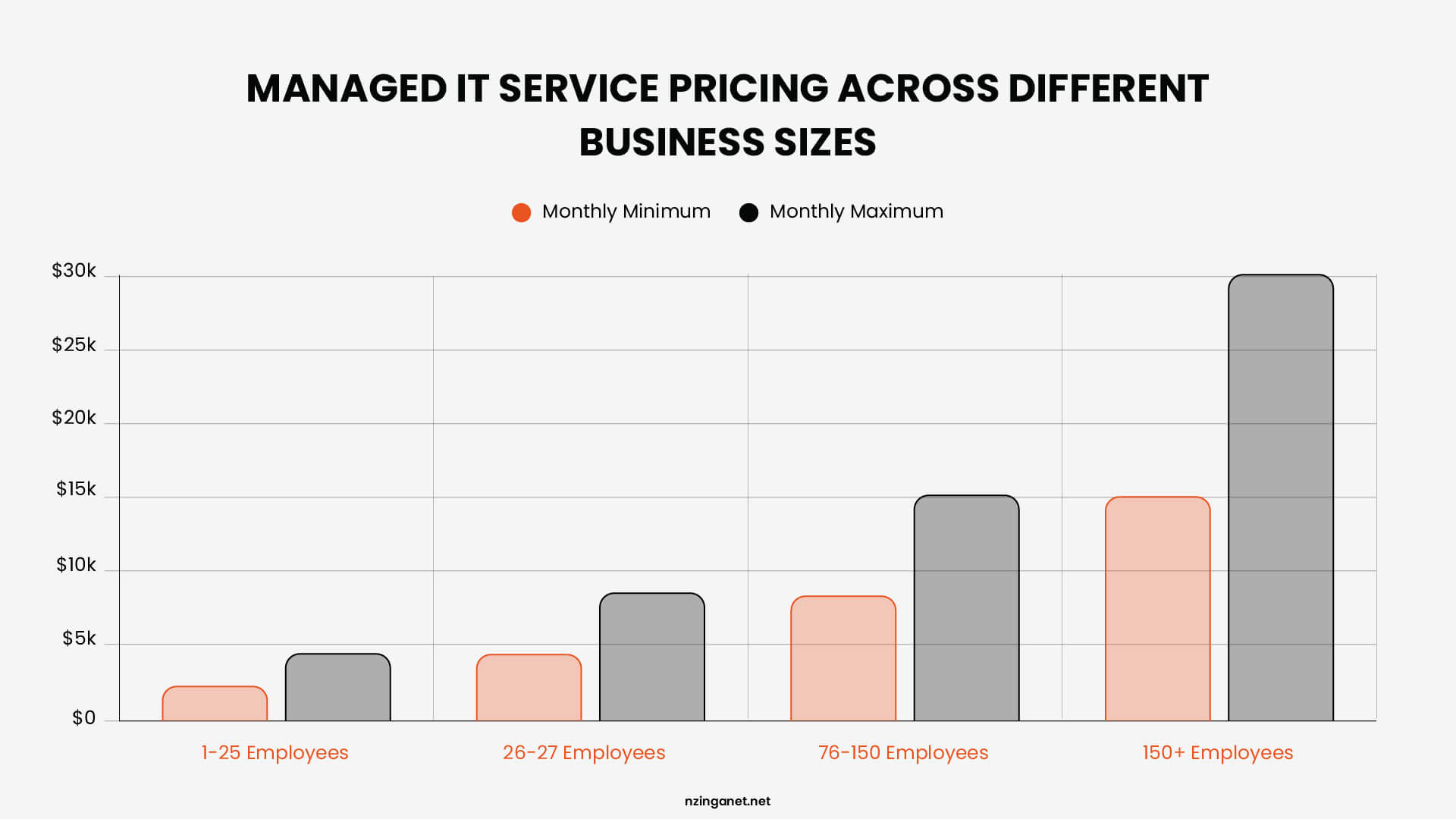
| Business Size | Employees | Monthly Cost Range | Common Model |
|---|---|---|---|
| Small | 1-25 | $500-$3,000/month | Per user or flat rate |
| Mid-Sized | 26-150 | $3,000-$15,000/month | Flat rate or tiered |
| Large | 150+ | $15,000+/month | Custom / co-managed |
Small Businesses With 1 to 25 Employees
Organizations at this size typically pay between $500 and $3,000 per month, depending on the complexity of their setup and the level of security included. Per user or flat rate models are common at this tier.
The challenge for smaller businesses is that they tend to have the least margin for error when something goes wrong, because operations depend on a small number of people and systems. Budgets are tighter and internal IT expertise is often absent entirely.
When thinking about the average cost of IT support for small businesses, prioritizing help desk responsiveness, solid backup and recovery, and foundational cybersecurity protection tends to deliver the most practical value at this size.
Mid-Sized Organizations With 26 to 150 Employees
This MSP pricing segment typically pays between $3,000 and $15,000 per month, with the range widening based on industry, infrastructure complexity, and security requirements. Flat rate and tiered pricing models are both common here.
Organizations in this range often begin encountering compliance requirements for the first time, particularly if they operate in healthcare, finance, or legal services. Those requirements add to the cost of managed IT services but also add a layer of accountability that reduces risk in meaningful ways.
The biggest driver of cost variation at this size is usually the depth of cybersecurity coverage and whether the agreement includes strategic services like IT roadmap planning or virtual CIO support.
Larger Businesses With More Than 150 Employees
At this scale, managed IT agreements are typically customized rather than packaged, and monthly costs run from $15,000 upward depending on the scope of the engagement. A number of organizations at this size use a co-managed model, where an internal IT team handles day-to-day operations while the managed service provider supplies specific expertise, tooling, or after-hours coverage that the internal team cannot maintain on its own.
SCOPE OF SERVICES
What Is and Is Not Typically Included in an MSP Pricing Agreement
This is the section that matters when you are comparing managed IT services pricing quotes from different providers. The monthly total means very little without knowing what is actually included in the fee and what falls outside it.
|
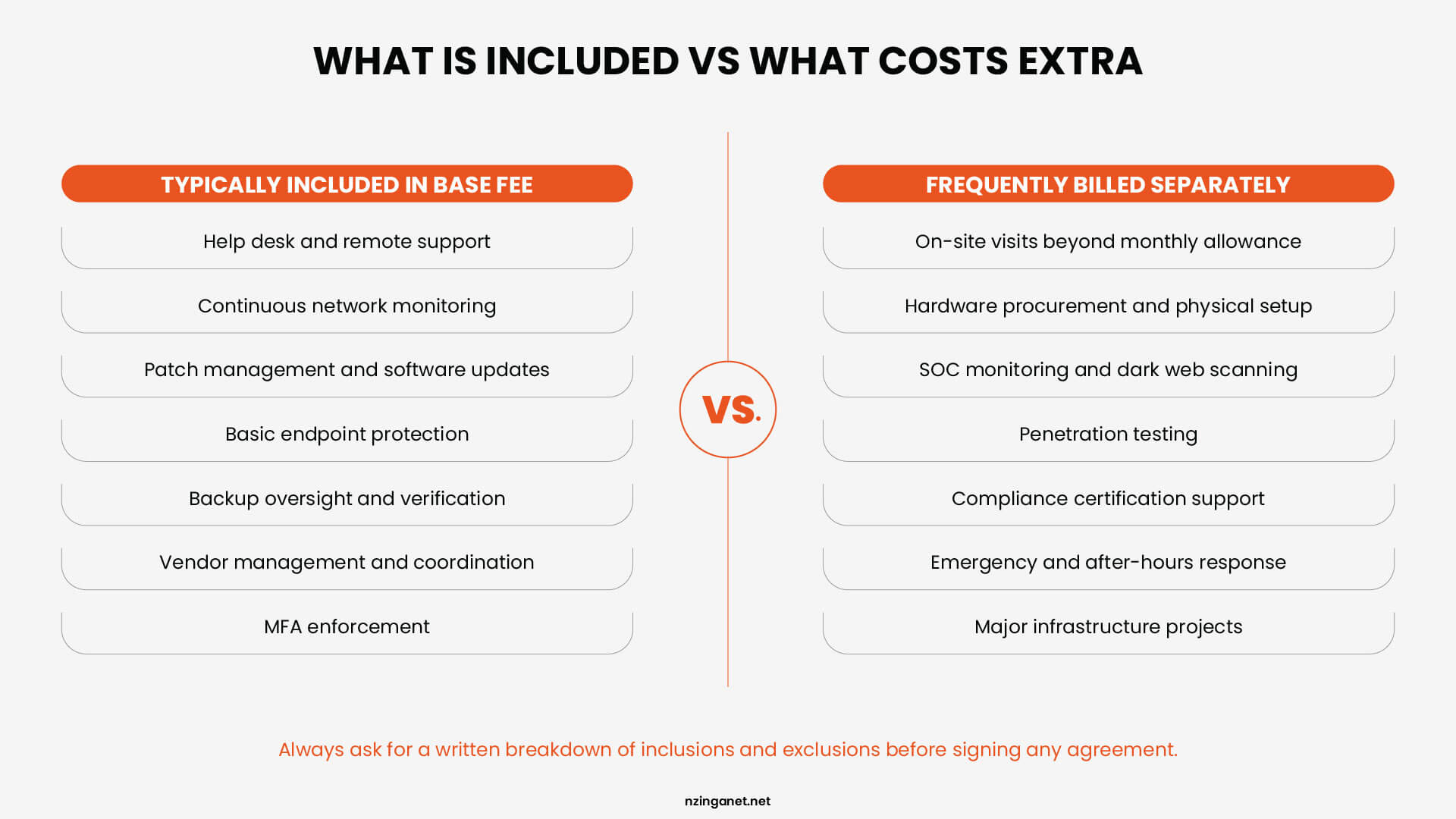
TYPICALLY INCLUDED IN BASE FEE ✓ Help desk and remote user support ✓ Continuous network monitoring ✓ Patch management and software updates ✓ Basic endpoint protection ✓ Backup oversight and verification ✓ Vendor management coordination |
FREQUENTLY BILLED SEPARATELY · On-site visits beyond monthly allowance · Hardware procurement and physical setup · SOC monitoring, pen testing, dark web scanning · Emergency or after-hours response · Server migrations and cloud transitions · Compliance-specific certifications |
Services Most Commonly Included in Standard Agreements
The majority of managed IT support packages include help desk and remote support for staff experiencing technical issues, continuous network monitoring to identify performance problems or unusual activity, patch management and software update deployment across covered devices, basic endpoint protection against malware and cyber threats, backup oversight to verify that data is being captured and can be recovered successfully, and vendor management to coordinate with software and hardware suppliers on your behalf.
These services form the foundation of any reliable agreement and represent the baseline of what you should expect before discussing additional coverage.
Services That Frequently Carry Additional Fees
On-site visits beyond a defined monthly allowance are among the most common sources of unexpected cost in managed IT relationships, particularly for businesses that assumed all support was included regardless of format. Hardware procurement and physical setup almost always sits outside the standard monthly fee.
Advanced cybersecurity services such as security operations center monitoring, penetration testing, dark web scanning, or support for achieving specific compliance certifications typically carry separate pricing that can add substantially to the total.
Emergency or after-hours response outside the standard service level agreement terms, major infrastructure projects like server migrations or cloud transitions, and compliance-specific work for regulated industries all commonly generate costs beyond the base agreement.
Understanding exactly where the boundaries of your agreement sit is one of the important things to clarify before signing a contract with any provider.
RETURN ON INVESTMENT
The Real ROI of MSP Pricing: Does It Actually Save Money?
This is the question decision-makers are really trying to answer, and it deserves a direct and honest response rather than a vague promise about efficiency gains.
For the majority of small and mid-sized businesses, managed IT services pricing delivers a return through reduced total technology-related costs, typically 20 to 40 percent lower than the fully loaded cost of equivalent in-house staffing and reactive support.
That range is wide because the actual outcome depends heavily on what your current IT situation looks like and how well you choose and manage the provider relationship.
Use the ROI Calculator Above
The interactive calculator at the top of this section lets you input your current employee count, internal IT staffing costs, downtime frequency, and preferred MSP tier to estimate your potential savings. Adjust the sliders to reflect your actual situation for the most relevant estimate.
The True Cost of Reactive IT Support
The cost of reactive IT is frequently underestimated because it shows up in places that do not get labeled as technology expenses. When a server goes down and your team spends four hours unable to access critical systems, that is lost productivity recorded as a labor cost rather than an IT cost.
When a security incident occurs because a patch was never applied, the cost of investigation, remediation, and potential regulatory response can reach tens of thousands of dollars for a business of any meaningful size.
Research on unplanned downtime consistently places the average cost between $8,000 and $25,000 per hour for small to mid-sized businesses when all contributing factors are included. Even at the lower end of that range, a single significant outage can cost more than several months of managed service provider pricing under a comprehensive agreement.
There is also the subtler cost of staff workarounds. When employees develop habits around a technology problem because reporting it feels like too much effort, productivity loss accumulates quietly in the background. Proactive management surfaces and resolves those issues before they become embedded in how people work.
Managed IT vs. In-House IT: An MSP Pricing Comparison
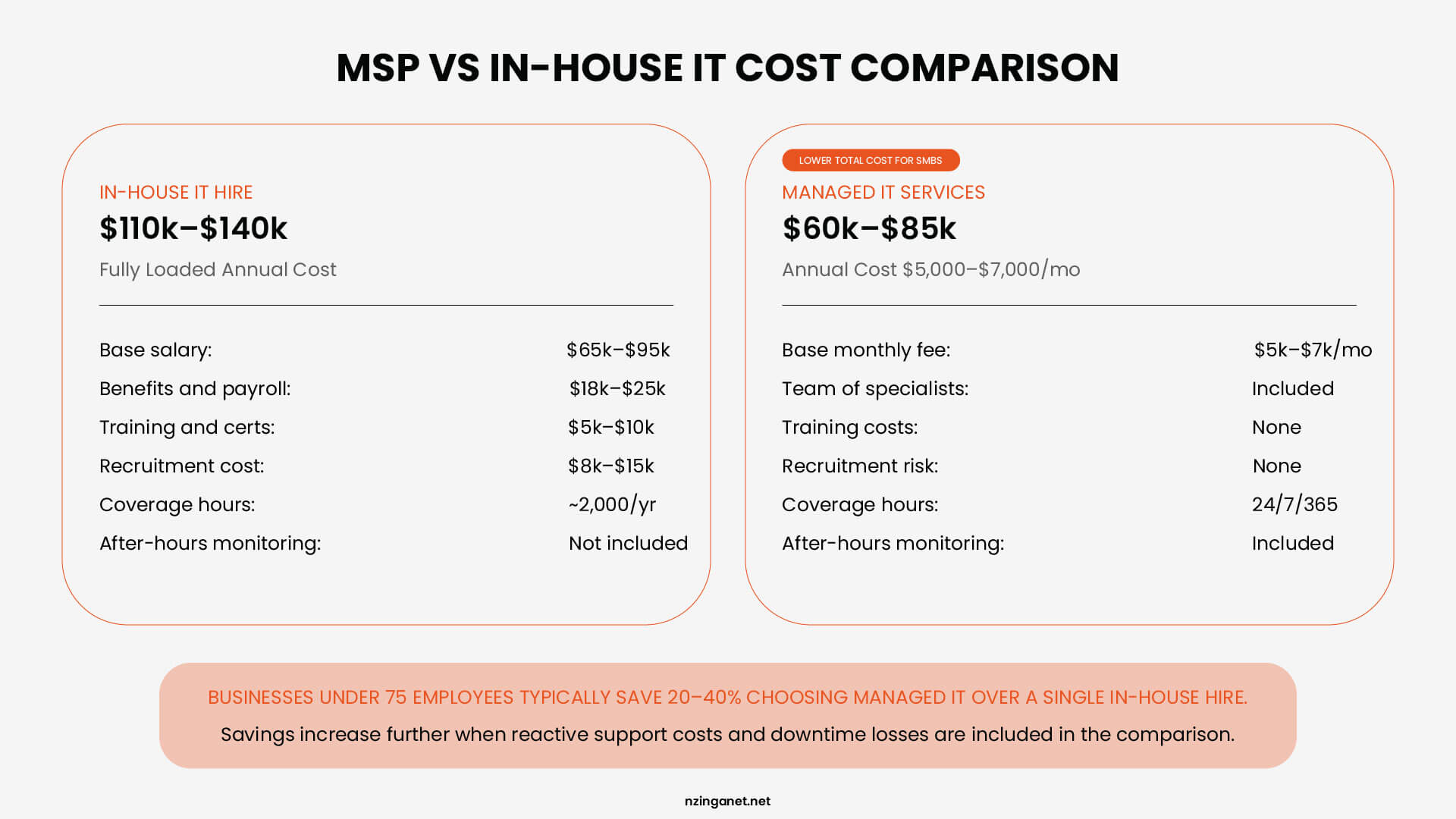
|
IN-HOUSE IT HIRE (ANNUAL) $110K-$140K Fully loaded annual cost · ~2,000 hrs/year availability · Single person expertise limits · No overnight monitoring · Vacation and sick day coverage gaps |
MANAGED IT SERVICES (ANNUAL) $60K-$85K At $5K/month (typical SMB) ✓ 24/7 continuous monitoring ✓ Multi-discipline specialist team ✓ No single-person knowledge gap ✓ Service continuity always assured |
A mid-level IT generalist in a major US market earns between $65,000 and $95,000 annually in base salary. When you add employer-side payroll costs, health benefits, paid time off, training and certification expenses, and recruitment costs when that person eventually leaves, the fully loaded annual cost of a single internal IT hire commonly reaches $110,000 to $140,000.
That person works approximately 2,000 hours per year, takes vacation, gets sick, and has limits on the breadth of expertise they can reasonably maintain. They cannot monitor your systems overnight. They may be strong in networking but limited in cybersecurity, or capable in day-to-day support but less equipped for strategic planning.
A managed services pricing arrangement at $5,000 per month, which is $60,000 annually, gives you access to a team of specialists across multiple disciplines, monitoring that runs continuously, and service continuity regardless of individual staff changes.
For businesses under roughly 75 employees, the comparison tends to favor managed services fairly clearly on cost grounds alone. Above that threshold, the right answer depends more on your specific needs and the complexity of your environment.
How to Estimate ROI for Your Own Organization
You do not need a complex spreadsheet to do a reasonable estimate of whether managed IT services pricing makes financial sense for your business.
Start with what you currently spend on IT support in all its forms, including reactive support calls, internal staff time spent troubleshooting, software subscriptions managed without oversight, and any recent incident costs.
Then estimate how many hours per month your operations are genuinely disrupted by technology problems and multiply that by what an hour of lost productivity costs your business across the affected staff.
Add a reasonable figure for security risk exposure based on how current your systems and protections are. Compare that combined figure against the monthly fee of a managed services agreement that covers the gap.
For businesses that have not taken a structured approach to IT management, that comparison tends to produce a result that favors managed IT services pricing by a meaningful margin.
The honest caveat is that ROI depends significantly on choosing a provider who actually delivers what the agreement promises, which is why the evaluation process before signing matters as much as the pricing itself.
COST DRIVERS
What Factors Drive MSP Pricing Up or Down?
Understanding the levers that affect your specific quote helps you interpret what you are being charged for and identify whether there are ways to structure an agreement that better fits your budget and priorities.
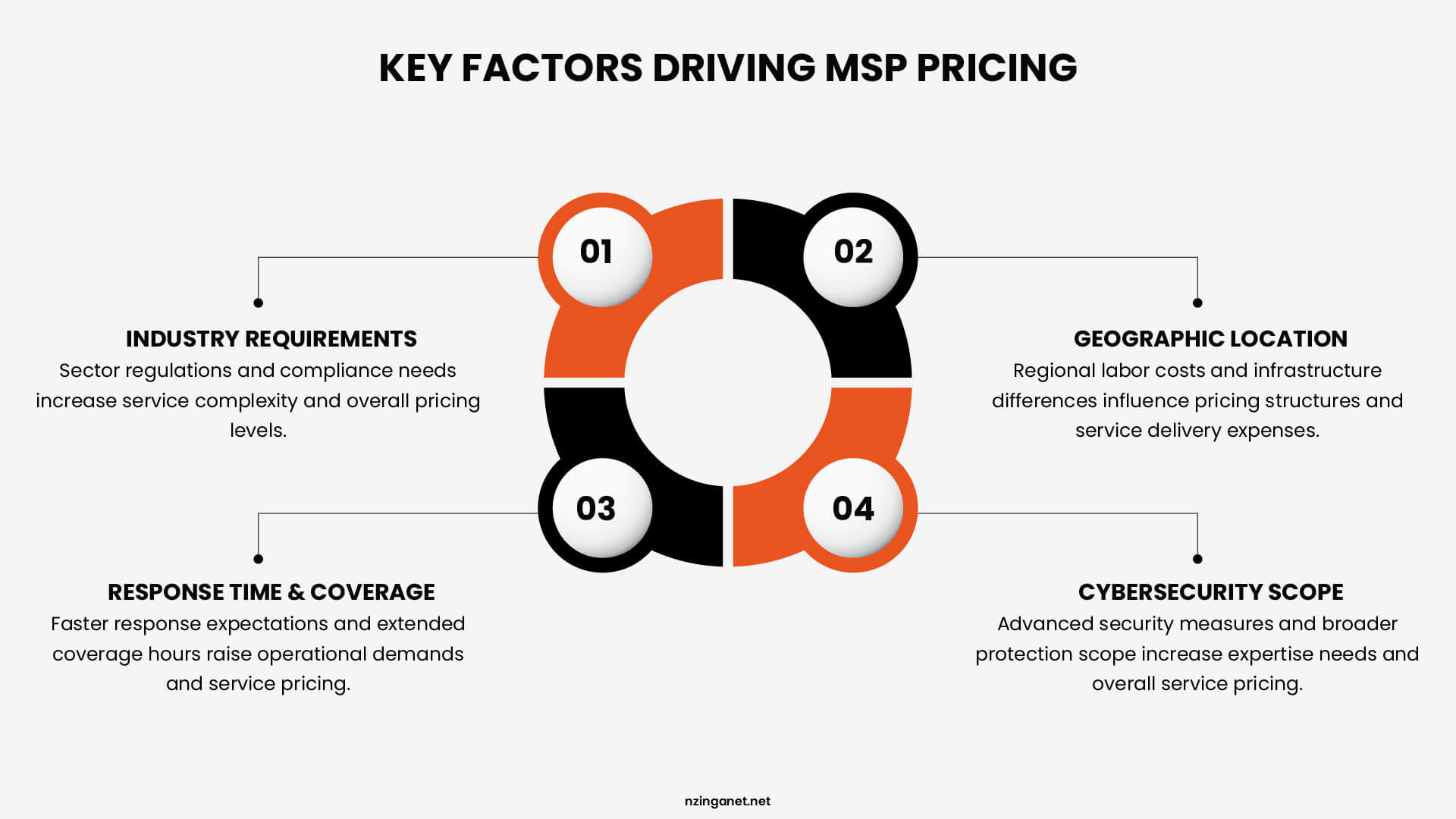
1. Industry and Regulatory RequirementsIndustry and regulatory compliance requirements are among the most significant cost drivers. Organizations in healthcare, financial services, and legal services typically pay at the higher end of managed IT pricing ranges because their environments require specific tooling, documentation, and processes to meet regulatory obligations. The additional cost is real, but so is the risk of non-compliance. |
2. Geographic LocationGeographic location affects pricing partly because local providers reflect local labor market costs and partly because on-site support in high-cost-of-living areas is more expensive to deliver. The age and complexity of your existing infrastructure matters considerably as well. A provider taking on a network with outdated equipment, inconsistent configurations, and no documentation is inheriting a greater ongoing workload than one onboarding a clean, standardized environment. |
3. Response Time and CoverageResponse time commitments have a direct and measurable effect on pricing. An agreement that guarantees a two-hour response for critical issues requires more staffing capacity than one with a next-business-day commitment. After-hours coverage adds cost because it requires dedicated resources outside standard working hours. |
4. Cybersecurity ScopeThe depth of cybersecurity services included in the scope is another significant variable. Basic endpoint protection is table stakes today. Advanced threat detection, security event monitoring, vulnerability scanning, and compliance-aligned security programs each add cost that reflects the genuine complexity and expertise required to deliver them reliably. |
BUYER'S GUIDE
How to Compare MSP Pricing Quotes Without Getting Misled
Getting multiple quotes is the right approach. Comparing them effectively requires knowing what to look for beyond the monthly total.
Questions Worth Asking Every Provider
Before signing with a managed service provider, it is important to clearly understand what you are actually paying for. The following questions help ensure there are no surprises later:
What Is Included in the Monthly Fee?
Ask for a precise breakdown of what services are covered under the standard monthly agreement and what services are considered outside scope. This prevents misunderstandings about what support is included versus what may trigger additional charges.
How Is On-Site Support Handled?
Not every MSP Pricing includes on-site visits in the base price. Ask whether on-site support is included, how often it can be requested, and what additional costs apply if technicians need to come to your location.
What Are the Guaranteed Response Times?
Request written service level agreements (SLAs) that define response times for different types of issues, such as critical outages versus routine requests. Also ask what happens if those response commitments are not met.
How Will Pricing Change as the Business Grows?
Understand how the agreement scales as your company adds employees, devices, or more complex infrastructure. A transparent provider should be able to explain how pricing evolves as your environment expands.
What Does the Onboarding Process Include?
Initial onboarding often involves network assessments, documentation, and system configuration. Ask whether this setup work is included in the agreement or billed separately.
How Can the Agreement Be Adjusted or Ended?
Clarify the contract terms, including how services can be modified and what the process looks like if the relationship needs to be terminated.
Red Flags Worth Paying Attention To
Vague scope language is the most common source of disagreement in managed IT relationships. If a contract uses broad terms without defining exactly what services are covered and under what conditions, that ambiguity will surface at the worst possible time, which is when you need support urgently.
Providers who cannot give you a clear, written service level agreement with defined response times are a concern regardless of how competitive their pricing appears. Unusually low managed services pricing relative to the market typically reflects something being excluded from the scope rather than genuine efficiency on the provider's part.
Pressure to sign quickly without adequate review time is worth treating as a signal about how the relationship is likely to be managed. A provider confident in their offering and their fit for your business has no reason to rush your decision.
INDUSTRY BREAKDOWN
Managed IT Services Pricing by Industry in 2026
Your industry is one of the most reliable predictors of where your MSP pricing will land relative to the standard market ranges.
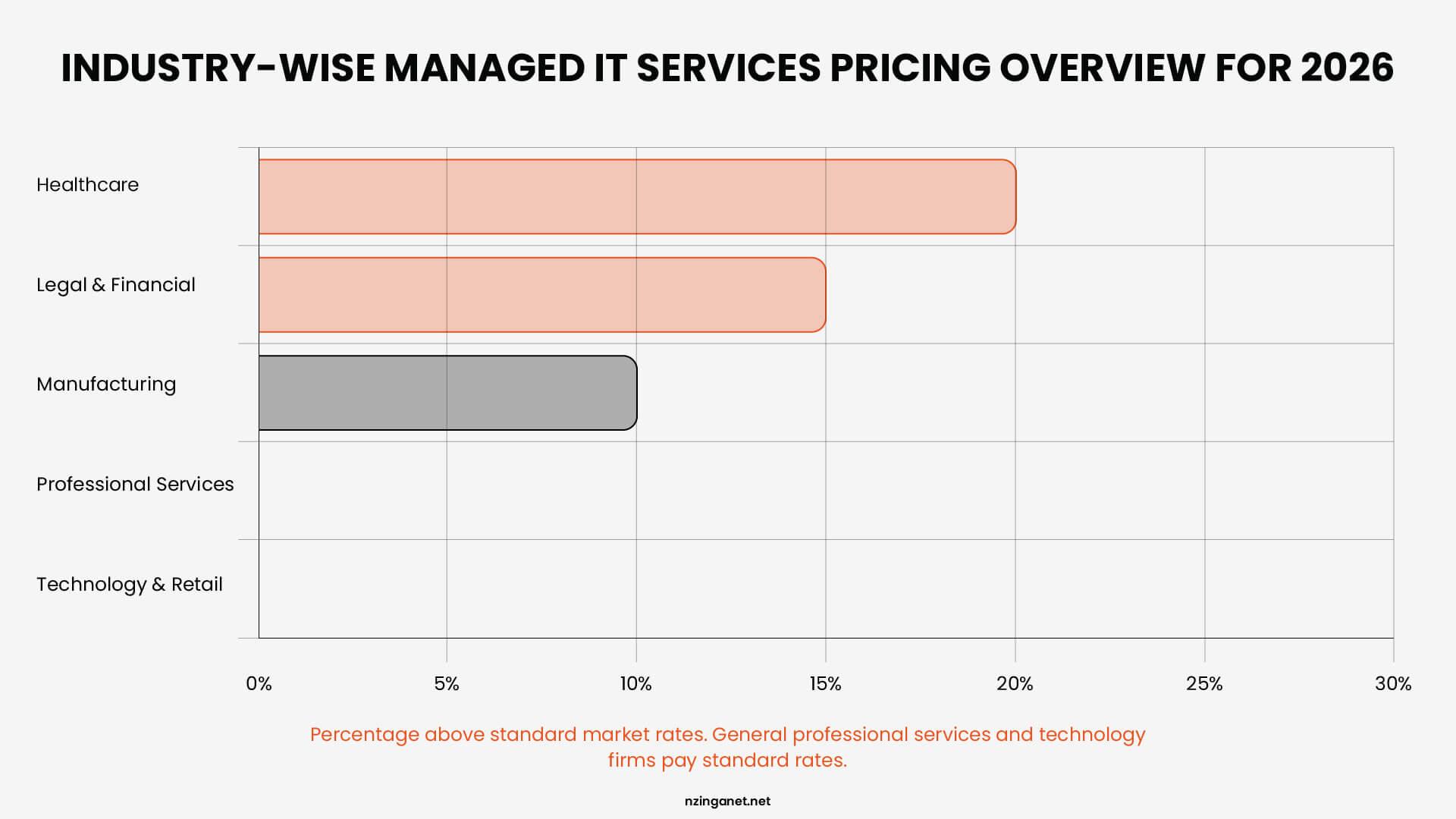
🏥 Healthcare OrganizationsHealthcare organizations, including medical practices, dental offices, and health systems, typically pay at the higher end of market rates because HIPAA compliance requirements create specific obligations around how data is stored, accessed, monitored, and reported. IT providers supporting healthcare clients must maintain particular tooling and documentation practices that add genuine cost to the engagement. |
⚖️ Legal and Financial ServicesLegal and financial services firms face similar dynamics, with data security requirements, client confidentiality obligations, and in some cases regulatory examination standards that shape what a managed IT engagement needs to include. Professional services firms in these sectors often need sophisticated access controls, audit logging, and security monitoring that pushes the cost of IT support above standard ranges for their size. |
🏭 Manufacturing and DistributionManufacturing and distribution businesses often have more complex network environments due to operational technology, equipment connectivity, and multi-site operations. That complexity tends to drive costs upward even when regulatory requirements are limited. |
💼 General Professional Services, Technology, and RetailGeneral professional services firms, technology companies, and retail businesses without specific compliance obligations typically access managed IT services pricing closer to standard market rates, with customization based primarily on size and service scope rather than industry-specific requirements. |
FINAL THOUGHTS
A Few Words on Evaluating Managed IT Services Pricing
The right MSP pricing arrangement is not necessarily the least expensive one. It is the one that covers what your business actually needs, from a provider that delivers what the agreement says they will, at a price that reflects genuine value relative to the alternative.
The cost of IT support delivered proactively and maintained consistently is almost always lower than the cumulative cost of reactive support, unplanned downtime, security incidents, and the staff frustration that comes from working in an environment where technology is a recurring obstacle rather than a reliable tool.
If you are at the stage of evaluating what managed IT services pricing might look like for your organization, NzingaNet works with businesses to provide clear, honest assessments of their current IT environment and straightforward guidance on what managed services would actually cover, cost, and deliver for their specific situation. If you want to start that conversation without any pressure to commit, schedule a consultation today.
NzingaNet serves small and mid-sized businesses across Pennsylvania with honest, straightforward IT assessments, no pressure, no vague promises. Ready to see what managed IT would actually cost for your specific situation?
COMMON QUESTIONS
Frequently Asked Questions
How much do managed IT services cost per month?
The cost of managed IT services for small and mid-sized businesses typically falls between $1,000 and $15,000 per month. On a per user basis, managed IT services pricing generally ranges from $99 to $350 per user per month. The wide range reflects genuine differences in service scope, organization size, industry requirements, and provider pricing models rather than arbitrary variation.
Is managed IT cheaper than hiring in-house IT staff?
For organizations under 150 employees, managed IT services cost tends to be lower on a total basis when the full cost of an internal hire is calculated accurately. A single mid-level IT employee with salary, benefits, training, and associated overhead typically costs $110,000 to $140,000 annually. A managed services agreement providing broader coverage and continuous monitoring often costs considerably less while eliminating the knowledge gap risk and coverage limitations of a single internal hire.
What is a typical MSP pricing contract length?
The majority of managed IT agreements run for one to three years. Month-to-month arrangements are available from some providers, typically at a higher per-unit rate that reflects the reduced commitment. Longer agreements often include better pricing and a more clearly defined onboarding investment from the provider.
What is the difference between managed IT services and break-fix support?
Break-fix support charges per incident and provides no ongoing oversight, monitoring, or maintenance between calls. Managed IT is a proactive, ongoing relationship where your provider monitors your systems continuously, applies updates on a regular schedule, and works to prevent problems rather than simply responding after they occur.
Do managed IT providers charge extra for cybersecurity?
Basic endpoint protection is included in the majority of standard IT support packages today. Advanced security services such as security operations center monitoring, penetration testing, dark web credential monitoring, and compliance-specific security programs typically carry additional fees that reflect the genuine expertise and tooling required to deliver them.
How do I know if an MSP quote is reasonable?
Compare scope before comparing MSP pricing. A lower monthly fee that excludes critical services will frequently cost more in practice than a higher-priced agreement with broader, clearly defined coverage. The most useful comparison is between quotes that cover equivalent services, which requires asking detailed questions about inclusions and exclusions from every provider before drawing conclusions from the headline numbers.
What is the average MSP pricing per user in 2026?
The national average for comprehensive managed IT services in 2026 ranges from $125 to $300 per user, per month. Basic monitoring and help desk packages typically start at $100-$150, while premium tiers including advanced security (SOC/SIEM) and compliance management range from $225 to $350+ per user.
How has managed IT services pricing changed in 2026?
Managed IT pricing in 2026 has shifted from per-device to all-in per-user models to support hybrid work. Key changes include mandatory cybersecurity bundling and AI surcharges of $25-$75 per user for automated threat detection. Additionally, providers are adopting outcome-based pricing, where fixed fees are tied directly to performance KPIs and business results rather than labor hours.
Are managed IT services worth it for small businesses?
Yes. For small businesses, MSPs typically reduce overall IT costs by 20%-30% compared to in-house hiring. They provide enterprise-grade security, 24/7 proactive monitoring, and scalable cloud expertise that prevents costly downtime. By 2026, the shift to AI-led cyber threats makes professional management essential for risk mitigation and business continuity.
READY TO GET YOUR MSP PRICING ESTIMATE?
Get an Honest Assessment of Your IT Budget
NzingaNet works with small and mid-sized businesses in Pennsylvania to deliver clear, straightforward managed IT services. No surprise fees, no vague SLAs, just honest pricing and real support.